
Asset-based real estate loans let investors qualify using the property's cash flow and value instead of pay stubs or tax returns. Lenders size the loan around net operating income, debt service coverage, and loan-to-value ratios, which makes these programs faster and more flexible than a conventional mortgage. They serve rental buyers, fix-and-flip investors, and developers scaling past the limits of traditional financing. The tradeoff is cost: rates and fees typically run higher than a bank loan.
TL;DR:
- Asset-based real estate loans primarily rely on property income and value, with key underwriting metrics being net operating income, DSCR, and loan-to-value ratio.
- These loans are suitable for rental properties, fix-and-flip projects, and construction, often allowing faster closing times and fewer personal income requirements compared to conventional mortgages.
- Higher interest rates and fees are typical, reflecting increased lender risk due to reliance on property performance rather than borrower income.
- Borrowers should prepare detailed rent rolls, operating statements, and asset documents, with an emphasis on verifying the property's income stability and reserve sufficiency.
- These loans carry risks such as refinancing difficulty if NOI or property value underperform, and a lower DSCR or vacancy issues can threaten approval or increase costs.
Table of Contents
- What Are Asset-Based Real Estate Loans?
- How Do Lenders Underwrite These Loans?
- Which Property Types Commonly Qualify?
- What Are Typical Terms, Costs, and Timelines?
- What Should You Prepare Before Applying?
- What Are the Risks and Downsides?
- Mayday Private Capital: How We Underwrite Deals and Support Investors
- A Quick Checklist for Deciding If This Financing Fits
- How Mayday Can Help You Move Forward
- Sources
- FAQ
What Are Asset-Based Real Estate Loans?
Asset-based real estate lending covers a handful of related programs, and the terminology gets muddy fast. In corporate finance, "asset-based lending" usually means a business borrowing against receivables or inventory. In real estate, the term shifts to mean something else entirely: property value and income become the central underwriting focus, not the borrower's W2.
There's also a personal-finance version called asset utilization or asset depletion, where a lender converts a borrower's liquid assets (cash, brokerage accounts, retirement funds) into a hypothetical monthly income using a divisor and a haircut on the balance. That method still leans on the borrower's financial profile rather than the property itself. Real estate investors more often mean property-first lending, and it breaks into a few standard products.
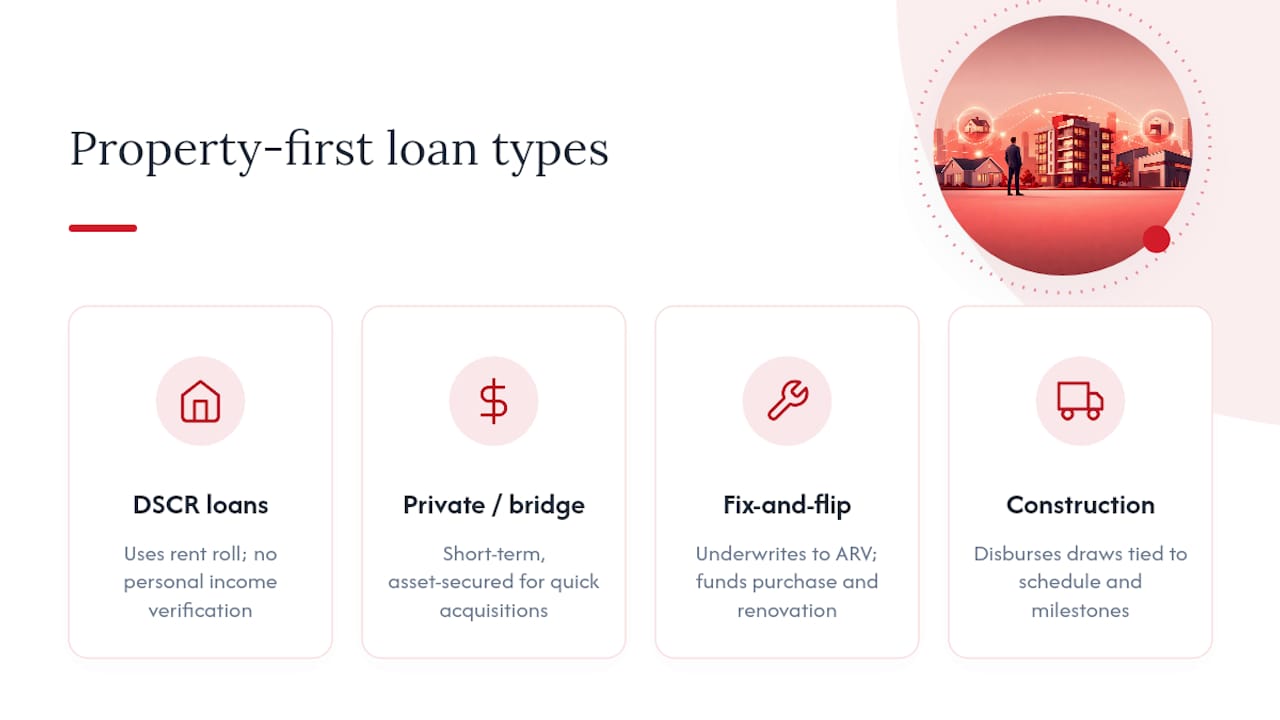
DSCR loans qualify a rental property using its own rent roll against the mortgage payment, with no personal income verification required. Private-money and bridge loans fund quick acquisitions or transitional properties, priced short-term and secured primarily by the asset. Fix-and-flip loans underwrite against after-repair value (ARV) rather than the property's current condition, funding both purchase and renovation. Construction loans disburse in draws tied to a build schedule and completed milestones.
Conventional mortgages verify income through tax returns, W2s, and debt-to-income ratios calculated on the borrower's personal finances. Asset-based programs replace that with a test of whether the property itself can carry its own debt. That single shift, from borrower income to asset performance, is what makes these loans usable for investors whose tax returns don't reflect their actual cash position.
How Do Lenders Underwrite These Loans?
Every asset-based real estate loan gets sized around three numbers: net operating income (NOI), debt service coverage ratio (DSCR), and loan-to-value (LTV). Get comfortable with these before you shop for a lender, because they determine how much you can borrow and at what price.
NOI is gross rental income minus operating expenses, excluding debt service, capital reserves, and depreciation. Property taxes, insurance, management fees, repairs, and utilities count as operating expenses; mortgage principal and interest do not. The OCC's Comptroller's Handbook walks through this calculation in detail because getting the expense classification wrong is one of the most common ways borrowers overstate a property's real performance.
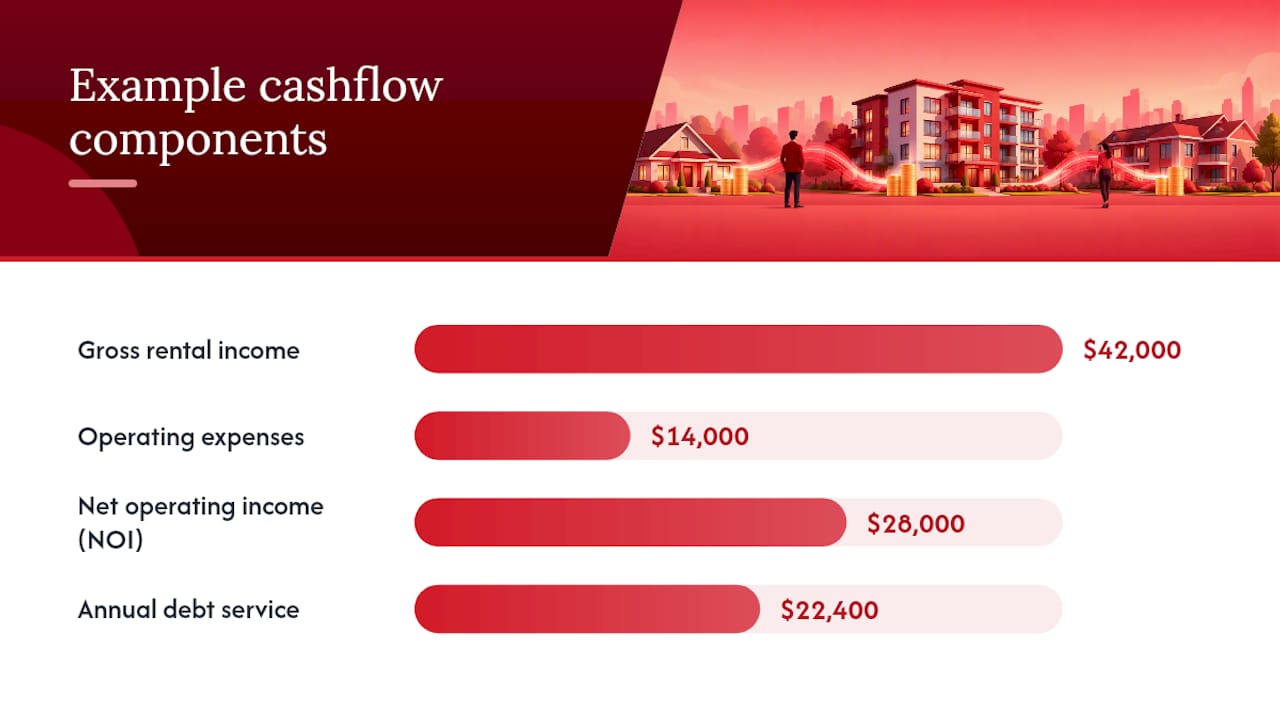
DSCR divides NOI by the annual debt service (principal and interest, sometimes taxes and insurance). A DSCR of 1.0 means the property breaks even on debt payments alone. Here's a worked example: a duplex generates $42,000 in annual rental income. Operating expenses run $14,000, leaving NOI of $28,000. Annual debt service on the proposed loan is $22,400.
Most DSCR lenders want to see a DSCR in the range generally considered acceptable or higher, though some programs allow lower ratios with a larger down payment or stronger borrower reserves.
Breakeven analysis asks what vacancy rate or expense increase would push DSCR down to 1.0. Regulatory guidance recommends stress testing that breakeven point against rising rates and vacancy, not just underwriting to a single optimistic scenario.
LTV works against DSCR in a way many first-time borrowers miss:
- A higher LTV means a bigger loan and a bigger debt-service payment.
- A bigger debt-service payment lowers DSCR at the same NOI.
- Lenders respond to weaker DSCR by either declining the loan, requiring a lower LTV, or charging a rate premium.
Run your own numbers before applying with Mayday Private Capital's DSCR calculator, which lets you test different loan amounts against a property's actual rent roll.
Which Property Types Commonly Qualify?
Lenders favor properties with income that's easy to verify and reasonably predictable. That usually means:
- Single-family and small multifamily rentals with signed leases and a rent roll
- Larger multifamily properties with stabilized occupancy
- Mixed-use buildings where the commercial component has a defined lease term
- Commercial properties with creditworthy tenants and multi-year leases
Use cases vary as much as property types. An investor scaling a rental portfolio typically uses DSCR loans property by property, qualifying each deal on its own cash flow rather than personal debt-to-income limits. A value-add buyer might use a bridge loan to acquire and stabilize a property, then refinance into a DSCR loan once occupancy and rents rise. Fix-and-flip investors borrow against ARV to fund both the purchase and renovation budget in one facility.
Construction and raw land are harder to place. There's no existing NOI to underwrite, so lenders lean more heavily on the sponsor's experience, a detailed budget, and a clear takeout plan (sale or refinance) once the building is complete.
What Are Typical Terms, Costs, and Timelines?
Terms vary meaningfully by product, but a few patterns hold across the industry. Bridge and fix-and-flip loans tend to run at lower leverage against purchase price but higher leverage against ARV, with LTV commonly capping near 70% and down payments landing in the 20% to 30% range for many asset-based property loans. DSCR loans often allow somewhat higher leverage on stabilized rentals with strong cash flow, though the exact ceiling depends heavily on the property's DSCR and the lender's risk appetite.
Pro Tip: Don't shop rate alone. A slightly higher rate with a lower origination fee and no prepayment penalty often costs less over a 12 to 24 month hold than the "cheaper" headline rate.
Expect these cost components on most deals:
- Origination fees, often quoted as points on the loan amount
- Appraisal, inspection, and title/escrow fees
- Interest reserve or cash reserve requirements, especially on bridge and construction loans
- Rate premiums over conventional financing, reflecting the speed and flexibility of underwriting
Asset-based loans generally price above conventional mortgages, which is consistent with regulatory guidance noting that CRE loans carry higher illiquidity and property-specific risk that lenders price into the rate.
Timelines run faster than a bank mortgage in most cases. A clean file with a preliminary review, appraisal, and title work in hand can close in two to four weeks; complex commercial deals or construction draws take longer.
What Should You Prepare Before Applying?
Lenders can only move as fast as your paperwork lets them. Build your package around these documents:
- Rent roll and lease copies for any occupied units, showing term, rate, and tenant history
- Operating statements for the trailing 12 months, or a pro forma for a new acquisition
- Bank and asset statements with enough seasoning (usually 60 to 90 days) to show the funds are legitimately yours
- Entity formation documents if you're borrowing through an LLC
- ARV and rehab budget with contractor bids, for fix-and-flip or value-add deals
Pro Tip: Lenders apply "haircuts" to retirement and brokerage balances, often crediting only a portion of the stated value, and they want statements that show the money has been in the account long enough to rule out a last-minute loan from a friend. Document that seasoning before you submit, not after underwriting asks.
The workflow itself is straightforward: submit the package for a preliminary review, order the appraisal and inspection, move through underwriting, then close. Mayday's DSCR loan document checklist breaks down exactly what a rental-property file needs, and the commercial property document checklist covers mixed-use and larger commercial deals.
What Are the Risks and Downsides?
Asset-based loans solve a real qualification problem, but they're not free of tradeoffs. The premium you pay over a conventional mortgage reflects genuine lender risk, not padding: faster underwriting and reliance on property performance rather than personal income both raise the lender's exposure if the deal underperforms.
- Rates and fees run higher than agency mortgages, which compresses margins on thin deals
- If NOI comes in below projection, refinancing out of a bridge loan can stall, leaving you stuck at a short-term rate
- Vacancy above your breakeven point, or an ARV that doesn't materialize after renovation, can turn a profitable plan into a cash drain
- The CFPB's ability-to-repay standards still shape how consumer-purpose loans get evaluated, so asset-based qualification doesn't eliminate every underwriting check
If your numbers only work under a best-case rent projection, or if you have access to cheap conventional financing and don't need speed, a traditional mortgage or bringing in equity partners is usually the safer path.
Mayday Private Capital: How We Underwrite Deals and Support Investors
Mayday Private Capital builds financing around the deal in front of us, not a rigid checklist. Our review looks at the property's income, your exit plan, and the broader investment strategy behind the purchase, which is a different conversation than most traditional lenders offer.
- Financing covers acquisitions, renovations, rental portfolios, and construction projects, offering products suited for various stages of investment scaling
- Preliminary reviews aim to provide early indication of whether a deal is financeable before committing significant time
- Bilingual support in English and Spanish helps facilitate clearer underwriting conversations for diverse investors
- New investors and borrowers with credit challenges receive individualized consideration of their deal's context beyond just credit scores
Our full program list, including eligibility notes for newer investors, sits on the loan programs page.
A Quick Checklist for Deciding If This Financing Fits
Three questions settle most of the "should I use asset-based financing" debate. First: does the property's actual cash flow support the debt, stress-tested for vacancy? If not, run the DSCR calculator again before you submit anything. Second: is your exit clear, whether that's a refinance, sale, or lease-up plan? If it's fuzzy, pause and firm it up. Third: do your reserves cover a slower-than-planned stabilization? If they're thin, build the cushion first.
— Angel
How Mayday Can Help You Move Forward
If your deal is bought on cash flow, not W2s, the products fit the way you actually invest: DSCR loans for stabilized rentals, fix-and-flip loans for renovation plays underwritten to ARV, private money loans for fast, flexible acquisitions, and ground-up construction financing for new builds.

First contact starts with a preliminary review, a straightforward conversation about your property, your numbers, and your plan, so you know quickly whether a deal is financeable rather than waiting weeks for an answer. There's no rigid income-verification wall to clear first; the property and the strategy behind it do the talking. If you're weighing a rental acquisition, a value-add rehab, or a ground-up build, run your numbers through the ARV and fix-and-flip calculator or the DSCR calculator, then apply directly to get a real answer on your deal instead of a generic rate quote.
Sources
- Examination Handbook 210 Appendix A, Income Property Lending, Financial Analysis (OCC)
- CFPB compliance guide: Ability-to-Repay and Qualified Mortgage (ATR/QM) rule
- Bluerate
- Understanding asset-based lending and its benefits (Western Alliance Bancorporation)
FAQ
What Are the Disadvantages of Asset-Based Loans?
The main downside is cost: rates and fees typically run above conventional mortgages because lenders take on more risk by underwriting the property instead of personal income. Refinance risk is the other big one. If NOI or property value falls short of projections, exiting a short-term loan on schedule can get difficult.
What Are the Downsides of a DSCR Loan?
DSCR loans qualify on rental income, so a vacant or underperforming property can quickly push the ratio below what the lender requires, jeopardizing approval or triggering a rate adjustment. They also tend to carry a rate premium over an owner-occupied conventional mortgage since there's no personal income backstop.
What Is the $100,000 Loophole for Family Loans?
This refers to a federal tax provision letting family members lend money to each other below a set threshold without triggering imputed-interest tax rules, a topic distinct from asset-based real estate lending. It applies to intrafamily loans generally, not to property-secured investor financing, so consult a tax professional for the current threshold and requirements.
Do DSCR Loans Require 20% Down?
Down payment requirements vary by lender, property type, and the resulting DSCR rather than a single fixed number. Many asset-based property loans land in the 20% to 30% down payment range, and a stronger DSCR can sometimes support a lower down payment, while a weaker one typically pushes it higher.
What Can Asset-Based Real Estate Loans Be Used For?
Investors use these loans for rental property acquisition, fix-and-flip purchases underwritten to ARV, bridge financing on transitional properties, and ground-up construction. Mayday Private Capital covers each of these categories with dedicated programs, including DSCR loans and private money loans for faster-moving deals.