
A construction completion loan is short-term financing that finishes a stalled or nearly-built project, replaces an exhausted construction facility, or clears a path to sale or permanent financing. Investors typically use one when the original lender cuts off funding, a contractor fails mid-build, or the project needs its final 10 to 20 percent of work done before it can convert to a takeout loan. The core mechanics are simple: draws release money in stages, and interest accrues daily only on what's actually been drawn.
TL;DR:
- Completion loans typically finance the final 10 to 20 percent of a project, with terms lasting six to 18 months and interest accruing only on drawn amounts.
- An accurate month-by-month draw schedule and contingency estimate are crucial for managing interest costs and avoiding budget shortfalls caused by the S-curve draw pattern.
- Lenders require detailed documentation, including an appraisal, cost-to-complete report, permits, and proof of contractor bonding, to approve and close efficiently.
- Final draw approval hinges on delivery of lien waivers, punch-list completion, and occupancy permits, with delays often caused by lien claims or incomplete paperwork.
- Borrowers can speed up approval and reduce risks by preparing all reports in advance, monitoring contractor status, and maintaining flexible communication with lenders.
Table of Contents
- What Does a Construction Completion Loan Cover?
- How Do Draws and Daily Interest Accrual Work?
- What Are Typical Loan Terms and Sizing Metrics?
- What Documentation Do Lenders Require for Approval?
- What Does the Final Draw Checklist Require?
- How Should You Present a Completion Loan Application?
- Why Do Construction Projects Stall in the First Place?
- What Do Completion Loans Typically Cost?
- How Long Does It Take From Application to Funding?
- How Can You Reduce the Risk of Default?
- How Do Completion Loans Affect Your Overall Budget?
- Lessons From an Investor-Focused Lending Perspective
- How Mayday Private Capital Can Help Finish Your Project
- Sources
- FAQ
What Does a Construction Completion Loan Cover?
A completion loan sits in a narrower lane than a full construction loan. A full construction loan funds a project from the ground up, including land acquisition and the entire build cycle. A completion loan steps in mid-project, funding only what's left. A finish-and-exit bridge goes one step further, combining the remaining work with a sales-period exit into a single facility, sized against finished value with the works tranche released against a quantity surveyor's cost-to-complete report.
Common triggers for needing this kind of financing include:
- The original construction lender hit its funding cap or pulled out entirely.
- A general contractor went under, walked off the job, or lost bonding.
- An investor bought a partially finished property at a discount and needs capital to close it out.
- The project needs 10 to 20 percent of work completed before a Certificate of Occupancy is possible.
Small-to-mid developers and investors who need short-term runway between a stalled build and a refinance or sale benefit most from this structure.
How Do Draws and Daily Interest Accrual Work?
Completion loans charge interest only on the amount you've actually drawn, not the full committed loan amount. That's the single biggest difference from a fixed-rate mortgage, and it's why the math takes a little more attention.
The standard formula, drawn from how construction lenders calculate simple interest, works like this:
- Take the outstanding drawn balance for the period.
- Divide the annual interest rate by the day-count convention (usually 360 or 365 days).
- Multiply by the number of days in the billing period.
- Multiply that result by the outstanding balance to get monthly interest owed.
Draw timing changes everything here. An even, straight-line draw schedule spreads interest cost predictably across the term. But most real builds follow an S-curve: slow at the start during permitting and site work, steep through framing and structural milestones, then tapering during finishes. That shape matters because a common shortcut, the 50 percent average outstanding-balance rule, assumes your average draw sits at half the loan amount for the whole term. In practice, an S-curve draw pattern can understate total interest in a noticeable percentage compared to that flat assumption.
Pro Tip: Build a month-by-month draw projection instead of relying on an average-balance shortcut. A basic construction loan calculator using a 0.5 average-draw factor is a fine starting point, but replace it with your actual anticipated draw schedule once you have contractor pricing in hand.
What Are Typical Loan Terms and Sizing Metrics?
Lenders size completion loans against loan-to-cost (LTC) for the remaining work and loan-to-gross-development-value (LTGDV) or loan-to-value (LTV) against the finished product. Terms run short by design, usually 6 to 18 months, because the whole point is to bridge a gap, not fund a decade-long hold.
- LTC on remaining costs commonly runs in the range lenders use for standard construction draws, adjusted downward when contractor continuity is uncertain.
- LTGDV or LTV against completed value tends to sit more conservatively than a clean exit bridge, since the lender is underwriting execution risk on top of market risk.
- Finish-and-exit facilities price higher than a straightforward exit bridge on a fully finished asset, because the lender is still exposed to construction risk until the CO is in hand.
- Expect origination fees, a possible exit fee, and third-party costs like appraisal and title work layered on top of the interest rate.
Contingency sizing moves the needle more than almost anything else. A thin or undocumented contingency line signals risk to underwriters and tends to tighten both leverage and pricing. Contractor status, meaning whether the original crew stayed on or a new one is stepping in cold, does the same.
What Documentation Do Lenders Require for Approval?
Underwriting for completion financing leans hard on documentation because the lender is buying into an unfinished story. Construction financing underwriters expect owner equity in the deal; very few will cover 100 percent of remaining costs.
Expect to provide:
- An appraisal covering both as-is value and as-completed value, often paired with a quantity surveyor's cost-to-complete report.
- The construction contract, a certified draw schedule, and current permit status.
- Title report and any environmental documentation tied to the site.
- Proof of contractor insurance and bonding, especially if the original contractor is being replaced.
Lenders also want to see how they're protected if the new contractor fails too, which is why bonding and insurance verification often gets more scrutiny on a completion loan than on a ground-up build. Review Mayday's DSCR loan document checklist for a sense of how documentation requirements carry over into permanent financing once construction wraps.
Pro Tip: Order your as-completed appraisal and cost-to-complete report before you approach lenders, not after. Having both ready cuts real time off the underwriting cycle because it removes the biggest variable a lender needs answered first.
What Does the Final Draw Checklist Require?
Lenders hold back the final draw until every box is checked, and that holdback is often the single biggest source of frustration for investors who thought they were done. Closeout procedures exist to protect the lender from lien exposure after money changes hands, so treat this checklist as non-negotiable rather than a formality.
- Final inspection report with all punch-list items signed off, plus a Certificate of Occupancy or use permit where the jurisdiction requires one.
- The contractor's final affidavit confirming all subs and suppliers have been paid.
- Unconditional final lien waivers from every subcontractor and supplier who touched the job.
- An updated title search, and where state law allows it, a recorded Notice of Completion to start the mechanic-lien filing clock.
- Confirmation that any take-out or permanent financing conditions are satisfied, and that retention amounts held back from contractors are released correctly.
Skipping any one of these is the fastest way to see a final draw delayed by weeks. A clean lien position isn't optional. Active claims block new lenders from closing at all.
How Should You Present a Completion Loan Application?
Lenders reviewing a completion request want to see that you understand exactly where the project stands and where it's going. A tight application packet moves faster than a padded one.
- Lead with an executive summary, a cost-to-complete breakdown, the draw schedule, and current permits status.
- Include contractor CVs or a resume for the replacement crew if the original contractor is gone.
- Document your pro-forma exit plan clearly, since lenders expect the takeout strategy defined at underwriting, whether that's a sale or a refinance into permanent debt.
- Negotiate on interest-reserve sizing, contingency percentage, inspection cadence, and staged release conditions before you sign, not after.
Watch for the red flags that stall approvals every time: mechanic liens already filed, budgets that don't reconcile between the original and revised scope, or permits that lapsed during the delay. Clear those before submitting, not during underwriting.
Why Do Construction Projects Stall in the First Place?
Most completion loans exist because something predictable went wrong. Contractor failure tops the list: a builder underbids the job, runs out of working capital mid-project, and either walks or gets fired. That leaves an investor holding a half-finished structure with a lender unwilling to keep funding a contractor relationship that's already broken.
Permit and inspection delays cause the second-biggest cluster of stalls. A jurisdiction flags a code issue, a required inspection gets rescheduled, or a zoning variance takes longer than planned, and the construction timeline slips past the original loan's maturity date. Material and labor shortages add another layer, particularly on projects that locked in pricing months before breaking ground and then hit supply gaps on windows, HVAC equipment, or skilled trade availability.
Budget overruns are their own category of trouble. A project that ran 15 percent over its original cost estimate can exhaust a construction facility before the last stretch of finish work even starts, leaving the investor short exactly when the building is closest to done. Weather delays, especially on projects in regions with hard winters or hurricane seasons, push timelines past a facility's maturity date more often than borrowers plan for.
Lender-side issues cause stalls too. A bank facing its own liquidity pressure, a change in underwriting appetite, or a loan that matures before the project does can all force a borrower to find replacement funding fast. None of these causes are exotic. They're the ordinary friction of construction, and a completion loan exists specifically to absorb that friction without forcing a fire sale.
What Do Completion Loans Typically Cost?
Pricing on completion financing runs higher than a standard construction loan, and higher still than a clean exit bridge on a finished asset, because the lender is underwriting both execution risk and market risk at once. Interest rates reflect that layered exposure, and the exact number depends heavily on contractor status, remaining scope, and the strength of your exit plan.
Origination fees are standard and typically charged as a percentage of the loan amount at closing. Many completion facilities also carry an exit fee, charged when the loan is paid off through sale or refinance, which some borrowers forget to model into their total cost of capital.
Third-party costs add up faster than borrowers expect. Budget for an as-completed appraisal, a cost-to-complete report from a quantity surveyor, updated title work, and possibly a Phase I environmental review if the original report has aged out. Legal fees for loan documentation and lien waiver review also belong in your cost estimate, especially on deals where the contractor changed mid-project.
The single most underestimated cost, though, is interest itself, because most borrowers model it with a flat average-balance assumption instead of their actual draw curve. Getting that number wrong by even 10 to 20 percent, which is exactly the gap the S-curve versus flat-average discrepancy produces, can eat into a contingency reserve that was already thin. Build your interest reserve off a real draw schedule, not a shortcut, and you'll avoid the single most common budget surprise on completion deals.
How Long Does It Take From Application to Funding?
Completion loans move faster than ground-up construction financing because the lender is evaluating a project that's already partly built and visible, not a set of plans on paper. Even so, the timeline depends heavily on how prepared your documentation is when you first apply.
A realistic timeline runs in three phases. Initial review and conditional approval, where a lender evaluates the deal's basic viability, cost-to-complete, and exit strategy, typically takes one to two weeks if your packet is complete. Full underwriting, which includes the as-completed appraisal, title work, and verification of contractor documentation, adds another two to four weeks depending on how quickly third-party reports come back. Closing and first draw funding can happen within days of clearing underwriting once lien waivers and insurance documentation are in order.
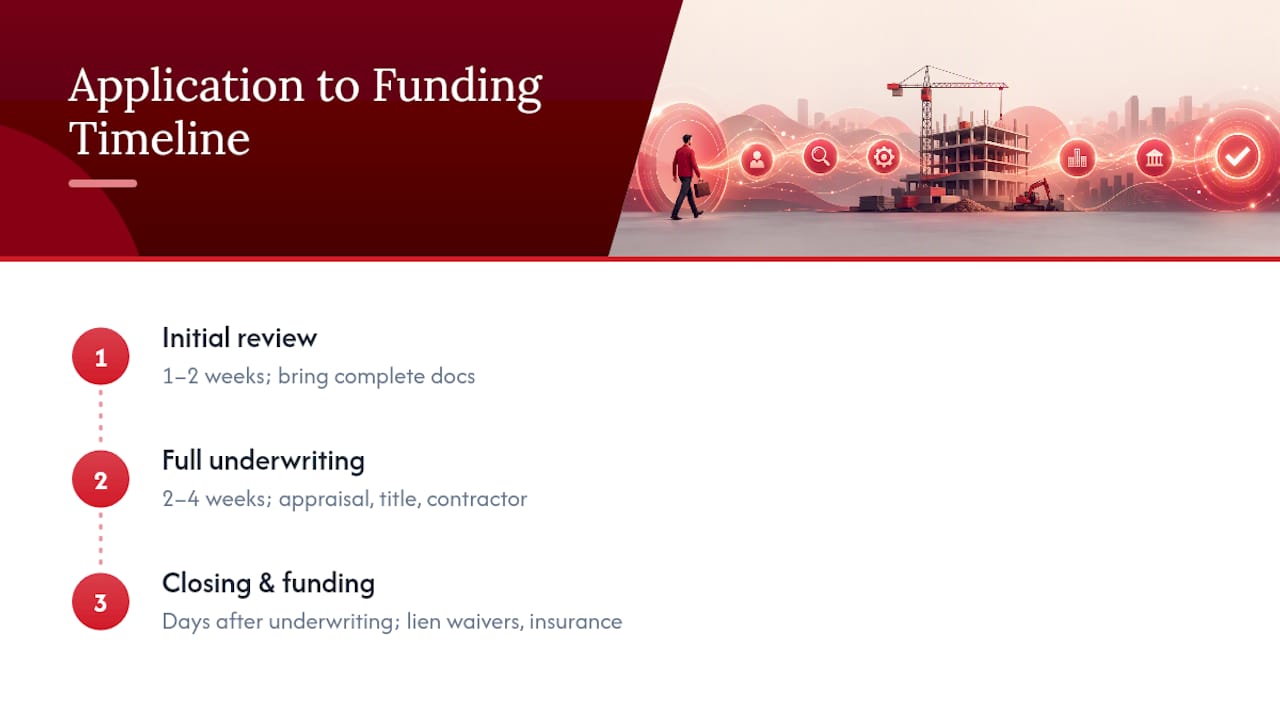
Total time from application to first funds released commonly runs four to eight weeks for a well-documented deal. Projects with unresolved liens, incomplete permits, or contractor transition issues can stretch well past that. The fastest path through this process is having your as-completed appraisal, cost-to-complete report, and updated title search ready before you submit, rather than waiting for a lender to request them one at a time.
How Can You Reduce the Risk of Default?
Default risk on completion financing usually traces back to one of three sources: underestimated costs, an unrealistic exit timeline, or a contractor who can't finish the job. Managing all three starts before you close, not after.
Size your contingency conservatively, and treat it as real money rather than a line item to shrink when the initial budget looks tight. A contingency built on optimistic assumptions is the fastest route to a cash shortfall three months into the build. Pair that with a draw-interest projection based on your actual construction schedule rather than a flat average, since underestimating interest cost is one of the more common ways a project runs short right before completion.
Vet your contractor's bonding and insurance status thoroughly, especially if this is a replacement contractor brought in after the original one failed. A second contractor failure on the same project is a realistic scenario lenders see often enough to underwrite around, and you should too. Keep your exit plan flexible: if the primary plan is a sale, have a refinance path mapped as a backup in case the market softens during your build window.
Communicate early with your lender if a delay looks likely. Lenders that offer staged release conditions and flexible inspection cadence, rather than rigid all-or-nothing draw triggers, give borrowers more room to manage a hiccup without tripping a default clause. Building that flexibility into the loan terms at closing, rather than trying to negotiate it after a problem surfaces, is the single most effective risk-mitigation step available to you.
How Do Completion Loans Affect Your Overall Budget?
A completion loan changes the shape of your project's cash flow, not just its total cost. Because interest accrues daily on the drawn balance rather than the full commitment, your carrying cost climbs gradually through the build and then compounds toward the back half if your draw schedule follows the typical S-curve pattern. That timing matters more than most investors expect when they're building a pro forma.
The interest reserve itself competes directly with contingency for the same pool of capital. Undersize the interest reserve, and you'll find yourself pulling from contingency to cover carrying costs, which leaves less cushion for the change orders and surprises that show up during finish work. That's exactly the scenario the 50 percent averaging trap creates when borrowers underestimate their draw curve.
Fees layered on top, origination costs, exit fees, and third-party report expenses, all hit your cash position at specific points rather than spreading evenly. Origination fees hit at closing, when cash is already tight from acquisition or prior construction costs. Exit fees hit at the moment you're trying to maximize proceeds from a sale or refinance. Mapping out when each fee lands against your projected cash position, rather than just totaling them into an overall cost figure, gives you a much clearer picture of whether the project stays solvent through completion.
Lessons From an Investor-Focused Lending Perspective
Most delays in getting a completion loan approved come from documentation gaps, not deal quality. Underwriters move fastest when they see a real cost-to-complete report, a certified draw schedule, and a contractor who's actually bondable, not just willing to finish the job on a handshake.
Model your draw interest against an S-curve, not a flat average, and size contingency like you expect at least one surprise, because you probably will. Lenders that offer quick preliminary reviews and bilingual support tend to move deals through underwriting faster simply because the conversation about the deal's real context starts on day one, not after a formal application sits in a queue.
— Angel
How Mayday Private Capital Can Help Finish Your Project
Mayday Private Capital is built for the investor whose project stalled and who needs a lender that reads the actual deal, not just the credit file. Whether you need ground-up construction funding to finish remaining work, a private money loan for a quick, flexible close, or a fix-and-flip loan structured around your exit timeline, the underwriting approach starts with your cost-to-complete report and draw schedule, not a rigid checklist that ignores context.

That investor-focused review means a faster preliminary read on whether your deal fits, including for first-time investors and borrowers who've hit credit friction with traditional lenders elsewhere. Bilingual support in English and Spanish means the conversation about your project's real situation doesn't get lost in translation either. If your build is stalled and you're ready to move, apply for financing and get a preliminary read on your completion deal.
Sources
- Explanation of Simple Interest Calculation — Bank of America
- Construction loan closeout — USA Construction Funds Management
- Interest reserve pitfalls — PropertyMetrics
- AGC guide to construction financing
- Construction loan calculator — Infinity Calculator
FAQ
What Is the Monthly Payment for a $200,000 Construction Loan?
During the build, most completion and construction loans charge interest-only payments on the drawn balance, not the full committed amount, so the payment grows as draws increase. Using the standard daily-accrual formula, a drawn balance at a typical short-term construction rate produces a materially different payment than the full committed amount once fully drawn, which is why a month-by-month draw projection matters more than a single average figure.
Do I Have to Put 20% Down on a Construction Loan?
Down payment requirements vary by lender and project risk, but construction financing rarely covers 100 percent of costs, so owner equity is expected regardless of the exact percentage. Completion loans specifically often require less cash down than a ground-up loan since the borrower already has equity built into the partially finished structure.
What Is the Monthly Payment on a $300,000 Construction Loan?
Like smaller loans, the payment depends entirely on how much of the committed loan amount has actually been drawn at any given point, since interest accrues only on the outstanding balance. Running your own draw schedule through a construction loan calculator gives a far more accurate monthly figure than assuming the full loan amount accrues interest from day one.
How Hard Is a Construction Loan to Get?
Approval difficulty depends heavily on documentation quality: a complete cost-to-complete report, certified draw schedule, and clear exit plan move an application through underwriting far faster than an incomplete packet. Lenders that emphasize investor-focused review, like Mayday's approach to ground-up construction financing, can offer quicker preliminary reads for borrowers who come prepared with solid documentation even if their credit profile isn't perfect.