
Most DSCR loans require a minimum 1.00 debt service coverage ratio, but the real target is 1.25 or higher if you want the best rates and leverage. Credit tiers matter more than advertised minimums this year: expect lenders to want 660–680 even though program floors sit at 620–640. Plan on roughly 20% down for stronger deals, up to around 30% for thinner ones, and six months of PITIA in reserves. Start by calculating your DSCR using gross rent divided by PITIA.
TL;DR:
- Most lenders require a DSCR of at least 1.00 for approval, but the best rates and leverage are available with a ratio of 1.25 or higher.
- To qualify for competitive terms, a credit score of 720 or above is ideal, though some lenders push effective minimums to 660–680 due to overlays.
- Down payments typically range from 20% to 30%, increasing significantly if your DSCR is close to 1.00 or your credit score is below 700.
- Lenders mainly focus on top-line gross rent and full housing payments, with six months of reserves generally needed regardless of DSCR level.
- Short-term rental income must be documented with trailing revenue and may be reduced by a 10 to 20 percent haircut to account for seasonality.
Table of Contents
- What Are the DSCR Loan Requirements at a Glance?
- How Do You Calculate DSCR for a Rental Loan?
- Which Credit Score Gets You the Best DSCR Terms?
- How Much Cash Do You Need for Down Payment and Reserves?
- What Property Types Qualify, and How Does STR Underwriting Work?
- What Documents and Appraisal Standards Do Lenders Require?
- How Do You Prepare Before Applying for a DSCR Loan?
- How Mayday Private Capital Supports DSCR Borrowers
- The Real Trade-Off in DSCR Financing
- Get a Preliminary DSCR Loan Review From Mayday
- Sources
- FAQ
What Are the DSCR Loan Requirements at a Glance?
DSCR lenders don't apply one flat rule. They move down payment, pricing, and approval odds up or down a sliding scale, and the deal's coverage ratio sits at the center of it. A stronger ratio buys you a smaller down payment and a better rate; a weaker one gets you a loan, but you'll pay for the risk.
| DSCR Band | Typical Down Payment | Rate Tier | Lender Stance |
|---|---|---|---|
| 1.25 or higher | 20% | Best available | Straightforward approval |
| 1.25–1.34 | 20–25% | Competitive | Standard approval |
| 1.00–1.24 | 25% | Elevated | Approvable, priced up |
| Below 1.00 | 30%+ | Highest | Case by case, often "no ratio" |
The DSCR calculation and 2026 threshold data shows a 1.25 DSCR as the practical line between "qualifies" and "qualifies with the best terms." Below that ratio, lenders still lend, but they lean harder on your down payment and credit to offset the thinner cushion.
There's also a gap between the program floor a lender advertises and what actually gets approved, known as the overlay. A published guideline might say DSCR loans are available down to 1.00. The lender's actual underwriting desk might quietly want 1.10 unless your credit and reserves are strong.
Regardless of ratio, every lender will require:
- A full appraisal supporting market rent
- Clear title
- Documented evidence of current or projected rental income
How Do You Calculate DSCR for a Rental Loan?
DSCR is a fraction: monthly gross rent divided by PITIA, principal, interest, taxes, insurance, and association dues combined. Lenders don't ask what you clear after repairs, management fees, or a bad month. They want the top-line rent number stacked against your full housing payment.
Here's how the math actually plays out:
- Pull the monthly PITIA. Say your mortgage payment, taxes, insurance, and HOA total $2,000 a month.
- Get the gross rent figure. A signed lease or an appraiser's rent schedule shows $2,500 a month.
- Divide rent by PITIA. $2,500 ÷ $2,000 = 1.25 DSCR, right at the sweet spot for competitive pricing.
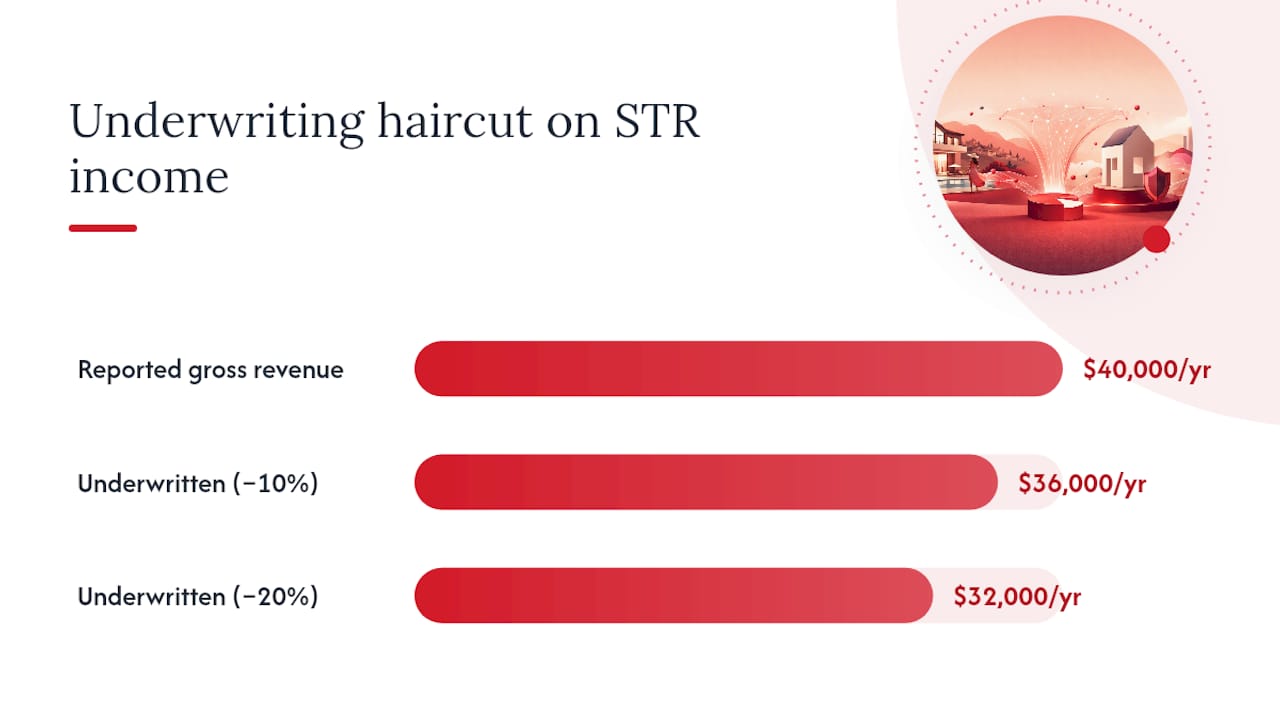
Short-term rentals complicate this. Lenders typically pull 12 months of trailing revenue from sources like AirDNA or your own booking platform, then apply a haircut of 10 to 20 percent to account for seasonality and off-season vacancy. A property grossing $40,000 a year on paper might get underwritten closer to $32,000 to $36,000.
Acceptable income documentation includes signed leases, an appraiser's Fannie Mae 1007 rent schedule, 12 months of STR platform statements, or a market-rent analysis when the unit sits vacant at closing.
Which Credit Score Gets You the Best DSCR Terms?
Your FICO score decides more of the deal than most investors expect. Here's how the tiers typically break down in practice:
- 720 and above: Best pricing available, standard 20% down on strong DSCR deals, minimal reserve friction.
- 700–719: Still competitive, but expect a small rate bump and closer reserve scrutiny.
- 680–699: Approvable at most lenders, often with a modest LTV cap or a quarter-point pricing hit.
- 660–679: This is where 2026 overlays bite hardest. Many lenders treat this as their real floor even when marketing materials say lower.
- Below 660: Financing gets harder to find and more expensive when it exists, usually with a larger down payment demanded to offset the risk.
Program minimums of 620 to 640 still exist on paper, but lender overlays have pushed effective approval thresholds up to roughly 660 to 680 at many shops this year. That gap between the advertised floor and the real approval line is the single biggest source of investor frustration in DSCR lending right now. Someone who qualifies on a spec sheet gets declined, or repriced, once underwriting actually runs the file.
If your score sits under 700, don't assume you're stuck. A larger down payment or a lender that reviews the whole deal, not just the credit pull, can often bridge the gap.
How Much Cash Do You Need for Down Payment and Reserves?
Down payment requirements track DSCR and credit together, not separately. A 1.30 DSCR with a 740 score gets you the lightest terms available; a 1.05 DSCR with a 670 score gets you the heaviest.
- 20% down: Reserved for deals with DSCR at 1.25 or higher and credit at 700 or above.
- 25% down: Standard for DSCR between 1.00 and 1.24, or for solid DSCR paired with credit in the high 600s.
- 30% or more: Common for no-ratio deals, weaker credit, or foreign national borrowers, who often face higher down payment norms industry-wide.
On reserves, six months of full PITIA in liquid funds is the standard ask, with some lenders requiring 12 months when the DSCR is thin. Checking, savings, and money market accounts count fully; retirement accounts usually count at a reduced percentage since they're not immediately liquid. Budget separately for closing costs, typically 2% to 3% of the loan amount, on top of your down payment and reserve cushion.
What Property Types Qualify, and How Does STR Underwriting Work?
DSCR loans cover non-owner-occupied investment property only. If you plan to live in even one unit, you're outside this loan category entirely.
- Eligible types: single-family homes, 2 to 4 unit buildings, and warrantable condos.
- Ineligible without a commercial loan: buildings of five or more units.
- Condo caveat: non-warrantable projects (high investor concentration, litigation, insufficient reserves) often trigger a lower maximum LTV or get declined outright at some lenders.
Short-term rentals get their own underwriting track. STR properties frequently carry a lower LTV cap than a comparable long-term rental, since income volatility runs higher. A beach condo that rents nightly in June and sits empty in February needs underwriting that accounts for both ends of that swing, not just the peak month.
What Documents and Appraisal Standards Do Lenders Require?
Every DSCR file runs through a similar document checklist, regardless of lender:
- Government-issued ID and a credit pull
- Two to three months of bank or asset statements showing reserves
- Signed lease or rent schedule supporting the income claim
- Executed purchase contract (for acquisitions) or current mortgage statement (for refinances)
- LLC formation documents and operating agreement, if the property closes in an entity name
Appraisals typically use Fannie Mae Form 1007 for rent schedules on single-family and small multifamily properties. Lenders order a second appraisal when the first comes back with unsupported comparables or when the loan amount crosses a threshold that triggers an automatic review. The lender program matrix data shows how much LTV limits and appraisal rules can shift by property type within a single lender's guidelines.
Common overlays beyond the published sheet: effective FICO lifts of 20 to 40 points above the stated minimum, extra reserve months on STR or condo deals, and state-specific restrictions in a handful of markets. Foreign national borrowers should expect to provide a passport, valid visa, and ITIN in place of a Social Security number, plus the higher down payment bands noted earlier. If your deal involves entity structuring across borders, resources on U.S. entity formation for investors are worth reviewing before you title the property.
How Do You Prepare Before Applying for a DSCR Loan?
Run your numbers before a lender does. Preparation is where most avoidable denials get fixed in advance.
- Calculate at least two DSCR scenarios: a conservative rent estimate and a stronger one, aiming for one that clears 1.25.
- If your credit sits below 700, plan for a larger down payment or spend 60 to 90 days improving your score first.
- Assemble your document pack, bank statements, leases, proof of reserves, and check Mayday's DSCR loan document checklist against it.
- Order a market-rent appraisal or STR revenue report before you're under contract deadline pressure.
- Confirm condo warrantability early if that's your property type.
- Ask any lender directly about their overlays, not just their published minimums, and request a preliminary review to surface issues before you're locked into a purchase contract.
Pro Tip: Run your DSCR at the rent an appraiser would actually support, not what a listing site estimates. Optimistic rent assumptions are the most common reason a deal that looked fine on paper falls apart in underwriting.
How Mayday Private Capital Supports DSCR Borrowers
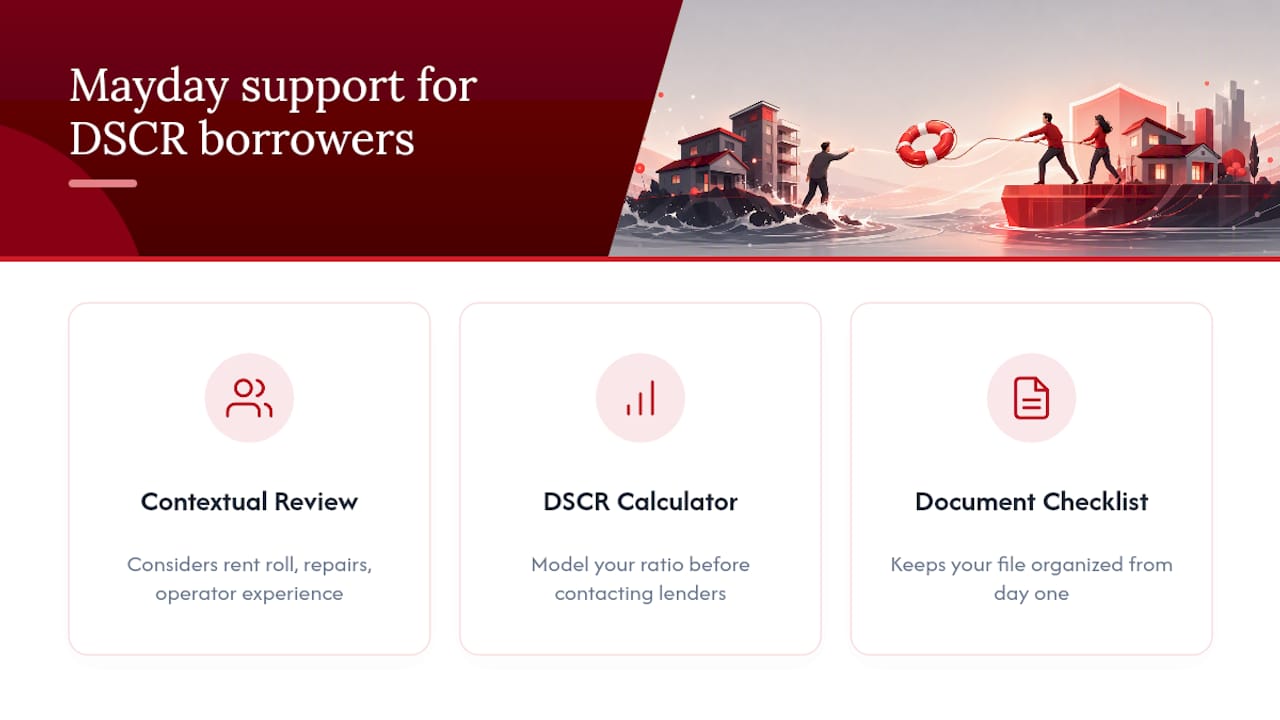
Program overlays and published floors only tell part of the story. What actually gets a deal closed is a lender willing to look at the whole picture, your rent roll, your repair scope, your experience as an operator, not just a credit score in isolation.
Some lenders review DSCR files with full context in mind, which matters most for investors who sit right at the edge of an overlay: a 670 credit score with strong reserves, or a property with a thin trailing STR history but a clear seasonal upside. The DSCR calculator lets you model your ratio before you talk to anyone, and the document checklist mentioned above helps keep your file organized from day one.
The Real Trade-Off in DSCR Financing
Every DSCR deal forces a choice between rate, leverage, and how much cash sits in reserve. Chase the lowest rate and you'll need a higher DSCR and stronger credit to get there. Chase maximum leverage and you'll pay for it in pricing or reserve requirements. Neither choice is wrong, but pretending you can optimize all three at once is how deals stall mid escrow.
My practical advice: run your numbers conservatively before you fall in love with a property, and get a lender's actual overlay policy in writing early, not after you're under contract and out of time to adjust.
— Angel
Get a Preliminary DSCR Loan Review From Mayday
Some lenders offer preliminary reviews that look at your actual rent roll, credit profile, and reserves together, helping you understand overlays before you're under contract.

Start by running your numbers through the DSCR calculator, then compare your document pack against the DSCR loan document checklist. From there, explore Mayday's DSCR loan programs, including options built for new investors and borrowers navigating credit challenges. Bilingual support in English and Spanish is available throughout. When you're ready, apply for a preliminary review and get a straight answer on where your deal stands before you're locked into a closing timeline.
Sources
- DSCR Loan Requirements 2026: What You Actually Need to Qualify | ProPilot Blog
- DSCR Plus v01.02.26
- Do I Qualify for a DSCR Loan? | Newfi
This article is general information, not a substitute for advice from a qualified financial advisor. Consult a qualified financial professional about your own circumstances before acting on anything here.
FAQ
How Hard Is It to Qualify for a DSCR Loan?
Qualifying is generally easier than a conventional mortgage because lenders skip personal income verification and focus on the property's rent versus its payment. The catch is that 2026 overlays have pushed effective credit minimums to around 660 to 680 even though program floors advertise lower, so approval difficulty depends heavily on which lender's actual desk reviews your file.
Can an LLC Do a DSCR Loan?
Yes, DSCR loans are commonly closed in an LLC's name, which is one reason investors prefer them over conventional financing. You'll need to provide formation documents and an operating agreement as part of your document pack, alongside your personal credit and reserve documentation.
What Is the Downside of a DSCR Loan?
DSCR loans typically carry higher rates and larger down payment requirements than conventional owner-occupied mortgages, often 20% to 30% or more depending on your ratio and credit. They also lean heavily on the property's income potential, so a deal with weak or unproven rent can be harder to finance even when your personal finances are strong.
What Are the Requirements for DSCR Financing?
At minimum, you need a DSCR at or above 1.00, though 1.25 or higher unlocks the best rates and leverage. Beyond the ratio itself, expect credit score thresholds in the 660 to 700 range, a 20% to 30% down payment depending on your deal, and six months of PITIA held in liquid reserves, with Mayday's DSCR loan programs among the options built to work with investors across that range.