
Yes, you can refinance with a DSCR loan, and both rate-and-term and cash-out versions are widely available across the U.S. market in 2026. If your goal is pulling equity for the next deal or exiting a hard-money bridge loan, DSCR cash-out refinancing is a proven path.
TL;DR:
- Most lenders allow DSCR cash-out refinances up to about 70% to 75% LTV for single-family properties, with slightly lower caps for multi-unit buildings.
- DSCR refinance rates typically range from 6.7% to 8.7%, depending on your DSCR, credit score, property type, and loan-to-value ratio.
- Achieving a DSCR of at least 1.0 usually requires a rent coverage ratio of 75% of gross rent or an appraised rent figure, which affects qualification.
- Seasoning periods before cash-out can vary from zero to six months, with some lenders permitting quick access, especially for fast BRRRR exits.
- If your DSCR is below 1.0, approval may still be possible with other tradeoffs, but expect higher rates and lower maximum loan amounts.
Table of Contents
- What Is a DSCR Refinance, and How Does Cash-Out Differ From Rate-and-Term?
- What LTV Limits, Seasoning Rules, and DSCR Floors Should You Expect on a Cash-Out Refinance?
- How Do DSCR Refinance Rates Work, and What Should You Budget For?
- What Documentation and Credit Profile Do You Need for a DSCR Refinance?
- How Do You Calculate DSCR Before Applying for a Refinance?
- What Are the Most Common Reasons DSCR Refinances Get Denied?
- When Should You Use DSCR Refinancing for BRRRR, Portfolio Growth, or Conventional Conversion?
- How Does a DSCR Refinance Affect Your Taxes and Financial Statements?
- What Are the Steps to Apply for a DSCR Refinance?
- How Long Does a DSCR Refinance Typically Take to Close?
- How Can You Improve Your DSCR Before Refinancing?
- How Do Property Types Affect DSCR Refinance Eligibility and Terms?
- When Should You Actually Pull the Trigger on a DSCR Cash-Out Refinance?
- How Does Mayday Private Capital Help You Complete a DSCR Refinance?
- Where Can You Verify Rates, Disclosures, and Tax Rules Yourself?
- Sources
- FAQ
What Is a DSCR Refinance, and How Does Cash-Out Differ From Rate-and-Term?
A DSCR refinance qualifies you based on what the property earns, not what you earn. Lenders divide gross rent by PITIA, your total monthly payment of principal, interest, taxes, insurance, and association dues, to get the debt service coverage ratio. A property renting for $2,500 with a $2,000 PITIA has a DSCR of 1.25. Most lenders require a minimum DSCR of around 1.0, with some seeking higher ratios near 1.20 for preferred pricing.
Rate-and-term refinancing replaces your existing loan without pulling extra cash. You're just adjusting the rate, the term, or both, and lenders generally allow higher leverage here since there's no new money leaving the deal. Cash-out refinancing is different: the new loan amount exceeds your current payoff, and the difference goes to you as usable capital. Because you're increasing leverage, cash-out LTV caps tend to be lower than what you'd get on a straight rate-and-term deal.
One detail investors underestimate: cash-out proceeds are loan proceeds, not income. The IRS doesn't tax them the way it would rental income or a sale. And because DSCR underwriting evaluates the property rather than your personal financial life, you typically skip the W2s, tax returns, and employment verification that bog down conventional refinances. That single feature, more than the rate itself, is why investors with multiple properties or nontraditional income gravitate toward DSCR products.
What LTV Limits, Seasoning Rules, and DSCR Floors Should You Expect on a Cash-Out Refinance?
Two-to-four-unit properties generally have somewhat lower LTV caps, often near 70%, because lenders view multi-unit cash flow as slightly less predictable.
Seasoning requirements vary by lender, commonly ranging from a few months up to half a year before you can cash out based on appraised value. Some lenders permit shorter seasoning periods but typically limit the loan amount to purchase price or appraised value during that time, which can restrict accessible equity early on. Seasoning and DSCR floor requirements swing widely by lender, with some shops allowing 0-month seasoning specifically to support fast BRRRR exits while others hold firm at six to twelve months.
What if your DSCR comes in under 1.0? Some lenders will still approve the loan with compensating factors, extra reserves, a lower requested LTV, or a stronger credit profile, but expect a rate adjustment and a reduced maximum loan amount.
Key takeaways on leverage and timing:
- Single-family cash-out: roughly 70% to 75% LTV is standard.
- 2 to 4 unit cash-out: often capped closer to 70%.
- Seasoning: three to six months is typical; zero-to-three months exists but usually caps your basis at purchase price.
- Sub-1.0 DSCR: possible with tradeoffs, not a guaranteed decline.
How Do DSCR Refinance Rates Work, and What Should You Budget For?
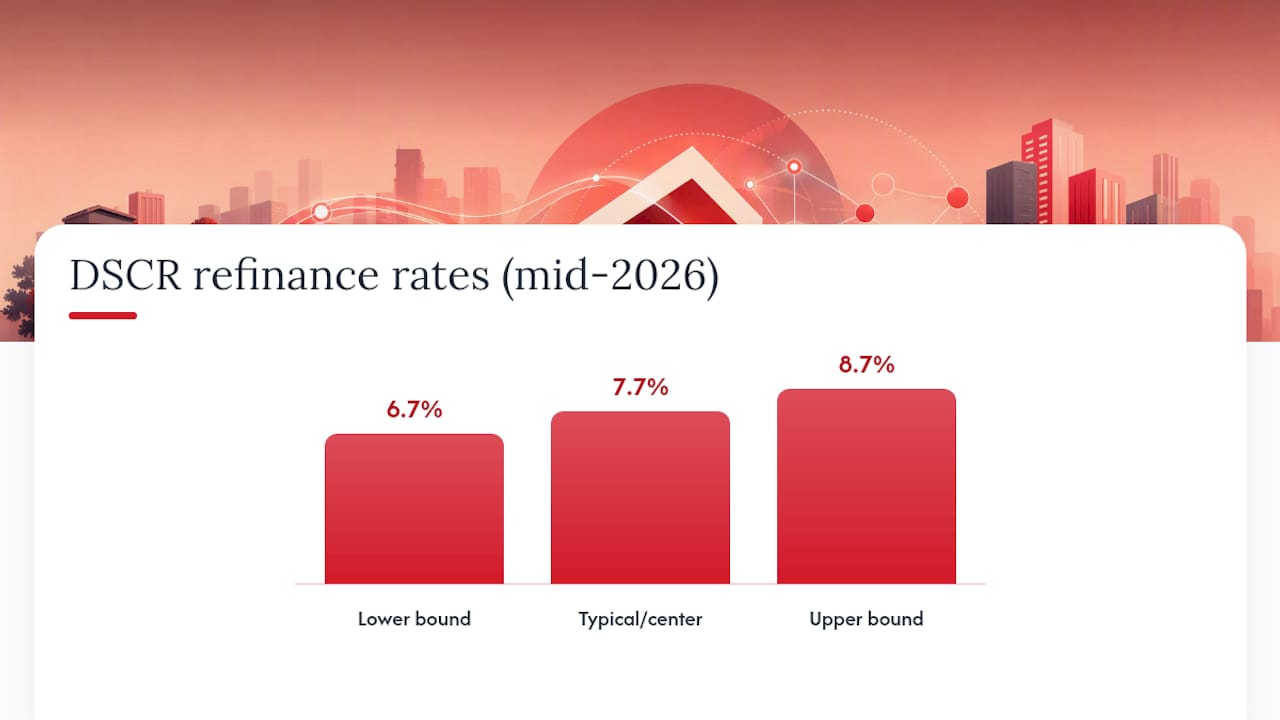
As of mid-2026, DSCR refinance rates generally fall in a range of about 6.7% to 8.7%, centered near 7.7%, according to rate data compiled by theLender. Actual pricing depends heavily on your specific deal, and lender filings back this up: one SEC investor presentation from a major DSCR originator disclosed a weighted-average DSCR loan rate around the mid-7% range across its portfolio, landing right inside that broader planning range.
Rates move with the broader bond market. Watch the Daily Treasury Yield Curve published by the U.S. Treasury; DSCR pricing tends to track shifts in medium-term yields with a lag of days rather than weeks.
Several factors move your individual quote up or down:
- DSCR ratio: a 1.25+ ratio usually earns better pricing than a 1.0 to 1.10 ratio.
- Credit score: the jump from the 660s to 740+ can meaningfully change your rate.
- LTV: lower leverage almost always buys a lower rate.
- Property type: single-family and small multifamily price better than short-term rentals or larger multi-unit buildings.
- Prepayment penalty structure: accepting a penalty typically buys a lower rate; waiving it costs you basis points.
A lower headline rate isn't automatically the better deal. Pro Tip: Always calculate the prepayment penalty break-even before comparing two offers. A loan at 7.4% with a 5-4-3-2-1 step-down penalty can cost more over 18 months than a 7.9% loan with no penalty, if you're planning to sell or refinance again soon. The CFPB's guidance on lender credits and discount points is a useful primer on how points shift your true cost basis, and it applies directly to weighing rate versus fees on a DSCR file.
What Documentation and Credit Profile Do You Need for a DSCR Refinance?
Credit score minimums for DSCR refinancing commonly begin near the mid-600s, improving at higher scores; lenders become more selective below the mid-600s.
Reserve requirements matter more here than in owner-occupied lending. Reserve requirements often range from a few months to about six months of PITIA for single properties; portfolio investors may need more extensive reserves to cover vacancies across multiple units.
Here's the typical document checklist a DSCR underwriter will request:
- Current lease agreements or, for vacant units, a market rent estimate.
- Two to three months of bank statements showing reserves.
- Your current mortgage statement for the property being refinanced.
- Schedule E from your most recent tax return, if you've held the property long enough to report rental income.
- Entity formation documents, if the property is held in an LLC.
- Proof of hazard and, where applicable, flood insurance.
- A rent roll or appraiser's Form 1007 rent schedule for multi-unit or recently acquired properties.
The appraisal does double duty on a DSCR refinance. The appraised value sets your maximum loan amount through the LTV cap, and the appraiser's opinion of market rent, often documented on Form 1007, sets the income side of your DSCR calculation. If your actual lease rent is below market, some lenders will let you use the higher appraised rent figure, which can be the difference between a 1.05 and a 1.20 DSCR. Bring comps and a clean rent history to support your case if you suspect the appraisal will come in soft.
How Do You Calculate DSCR Before Applying for a Refinance?
Running your own numbers before you talk to a lender saves time and prevents a wasted application. Here's the workflow, using a duplex renting for a combined $3,200 a month as an example.
- Establish qualifying rent. Lenders often discount gross rent by a vacancy factor, commonly using 75% of gross rent, or they use the appraiser's market rent figure directly. On $3,200 gross, a 75% factor gives you $2,400 in qualifying rent; many DSCR lenders instead use full appraised rent, so check which method your lender applies.
- Calculate PITIA at your proposed rate and term. Say a $320,000 loan at 7.7% over 30 years runs about $2,280 a month in principle and interest, plus $350 for taxes, insurance, and HOA, for a PITIA near $2,630.
- Divide rent by PITIA to get DSCR. Using full appraised rent of $3,200, that's $3,200 ÷ $2,630, a DSCR of 1.22. Using the discounted $2,400 figure, it's $2,400 ÷ $2,630, or 0.91, below most lenders' floor.
That gap between the two methods is exactly why you confirm your lender's rent-calculation approach before assuming you qualify. Once DSCR clears the floor, apply your LTV cap to the appraised value to find your maximum loan, then subtract your existing payoff and estimated closing costs to see actual cash in hand. Use Mayday's DSCR calculator to run this math against your own numbers before submitting an application.
What Are the Most Common Reasons DSCR Refinances Get Denied?
DSCR shortfall is the number one reason files stall. If your ratio lands at 0.95 against a lender's 1.0 floor, you have three practical fixes: request a smaller loan amount to lower PITIA, shop lenders whose floors sit at 0.75 to 0.80 for a rate tradeoff, or restructure the loan term to stretch payments over more years and shrink the monthly payment.
Appraisal surprises are the second-biggest killer. A value that comes in below expectation shrinks your LTV headroom instantly. Combat this by walking the appraiser through recent capital improvements, providing your own comps, and supplying a documented rent history rather than relying on the appraiser's independent rent estimate.
Prepayment penalties cause a different kind of pain: they don't kill the deal, but they quietly erode your returns if you refinance again or sell within the penalty window. Always model your break-even before signing. Pro Tip: If you know you'll refinance or sell within two years, ask about a no-penalty option even at a slightly higher rate, it often nets out ahead once you factor in the step-down penalty you'd otherwise owe.
Timing trips up BRRRR investors specifically. If you need a fast cash-out to redeploy capital, target lenders with short or zero seasoning windows rather than the market standard of three to six months.
When Should You Use DSCR Refinancing for BRRRR, Portfolio Growth, or Conventional Conversion?
The classic BRRRR sequence runs hard-money purchase and rehab, stabilize the property with a tenant in place, then DSCR cash-out refinance to repay the bridge loan and recycle capital into the next deal. Expect most lenders to want at least some seasoning, though as covered above, a subset offer zero-month options built specifically for this exit.
For investors scaling past four or five financed properties, DSCR refinancing sidesteps the conventional mortgage market's well-known 10-property limit and its full personal-income documentation demands. That's the structural reason larger portfolio landlords lean on DSCR products even when their income would otherwise qualify them for agency financing.
Converting a DSCR loan to conventional financing later can make sense once your income documentation is clean and stable, since conventional rates often run lower. The tradeoff: you'll need full income verification, acceptable personal-title vesting requirements, and you'll bump back into that property-count ceiling if you're scaling aggressively.
How Does a DSCR Refinance Affect Your Taxes and Financial Statements?
Cash-out proceeds from a DSCR refinance aren't taxable income. The IRS treats refinance proceeds as loan debt, not earnings, so pulling $60,000 out of a rental doesn't create a tax bill in the year you receive it. What does change is your interest expense, which typically rises since you're borrowing against a larger balance, and that expense is generally deductible against rental income reported on Schedule E.
Your balance sheet shifts more visibly than your tax return. The refinance increases your liabilities by the new loan amount while your equity position in that property drops by roughly the same amount you extracted. Lenders evaluating your next deal will see a higher loan balance against the property and a lower calculated equity cushion, which can affect future underwriting if you're applying elsewhere with a portfolio-wide reserve requirement.
Points and closing costs on a refinance are treated differently than they are on a purchase. Rather than deducting them in full the year you pay them, you generally amortize refinance points over the life of the loan. If you refinance again or sell before the loan matures, any remaining unamortized points typically become deductible in that final year. A tax professional familiar with real estate should confirm the details for your specific entity structure, since LLC-held properties and personally titled properties can carry different reporting nuances.
What Are the Steps to Apply for a DSCR Refinance?
The process moves faster than a conventional refinance because there's no employment or income verification to chase down, but it still follows a clear sequence.
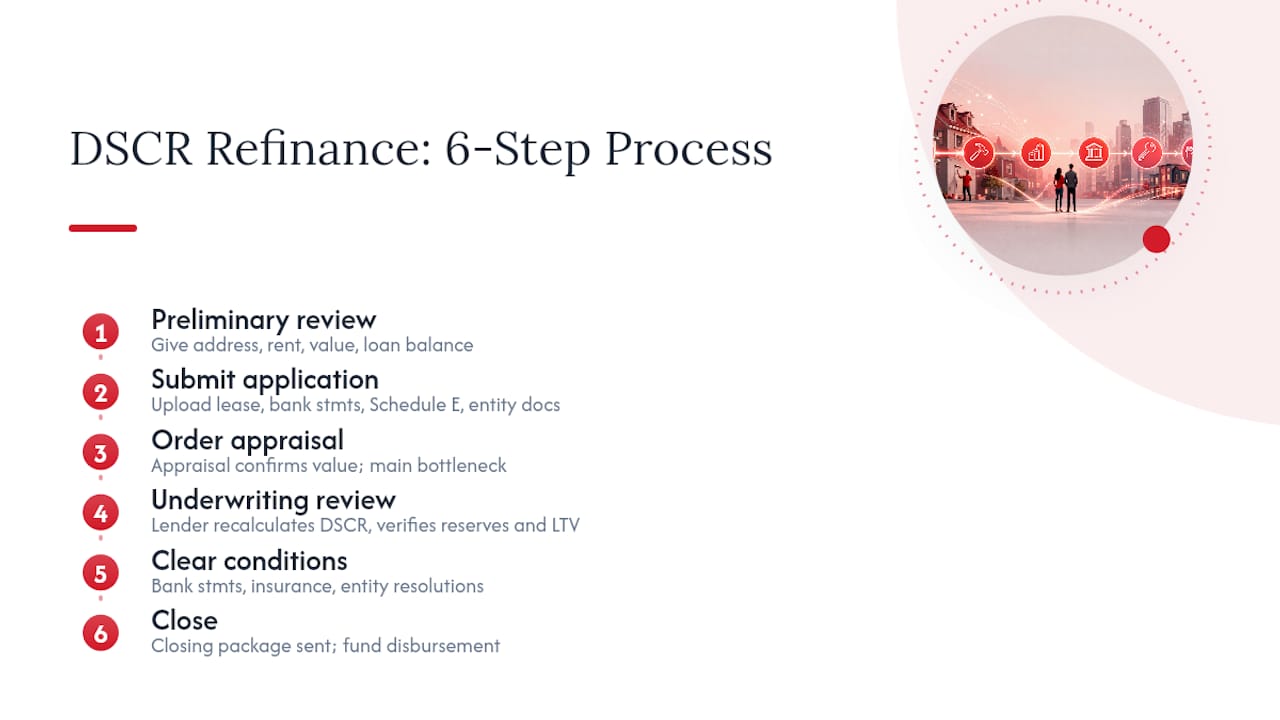
Start with a preliminary scenario review. Give a lender your property address, current rent, estimated value, and existing loan balance. Most DSCR lenders can tell you within a day or two whether the deal pencils out.
Submit your formal application and documents. This is where your lease agreements, bank statements, Schedule E, and entity paperwork come into play, all the items covered in the documentation checklist above.
Order the appraisal. The appraiser confirms value and, on rental properties, documents market rent through a Form 1007 rent schedule.
Underwriting review. The lender recalculates your DSCR using the appraised figures, verifies reserves, and confirms the LTV against the new appraised value.
Clear conditions and close. Any underwriting conditions, updated bank statements, insurance binders, entity resolutions, get satisfied here before the closing package goes out.
Because DSCR underwriting skips personal income verification, the biggest bottleneck is almost always the appraisal turnaround, not paperwork on your end.
How Long Does a DSCR Refinance Typically Take to Close?
Most DSCR refinances close in three to five weeks from application to funding, assuming your file is clean and the appraisal comes back without complications. The appraisal itself is usually the longest single step, often taking one to two weeks to schedule and complete depending on your market and property type.
Files move faster when the borrower has documents ready upfront, current lease, mortgage statement, and bank statements, rather than gathering them after the lender asks. Portfolio investors refinancing multiple properties at once should expect timelines to stretch, since appraisals and title work often need to be sequenced property by property rather than run in parallel.
Rate-and-term refinances tend to close slightly faster than cash-out deals, since there's less scrutiny on how proceeds will be used and no need to verify the deal doesn't run afoul of a lender's seasoning rule. If you're working against a hard-money maturity date or a prepayment deadline on your current loan, tell your lender that timeline upfront so they can flag any steps that might need to be expedited.
How Can You Improve Your DSCR Before Refinancing?
Raising rent is the most direct lever. If your lease is below market, even a modest increase at renewal, backed by comps, can move your DSCR from a marginal 0.98 to a comfortably qualifying 1.10 or higher.
Paying down the loan balance before refinancing lowers your PITIA and mechanically improves DSCR, though this only makes sense if you have idle capital and aren't better off deploying it elsewhere. Shortening or lengthening your loan term also shifts the ratio: a 30-year term instead of a 20-year term lowers your monthly payment and raises DSCR, even though it costs more in total interest over time.
Cutting controllable expenses helps too. Shopping your insurance policy, appealing an inflated tax assessment, or renegotiating HOA-adjacent service contracts all reduce PITIA without touching the loan itself. Finally, timing matters: if a rent increase or expense reduction is already in motion, waiting 60 to 90 days to let it show up on your books, or on a fresh appraisal, can be the difference between a decline and an approval.
How Do Property Types Affect DSCR Refinance Eligibility and Terms?
Single-family rentals get the most favorable treatment across the board, the highest LTV ceilings, the broadest lender selection, and generally the best pricing. Two-to-four-unit properties still qualify easily but usually see LTV caps trimmed by a few points compared to single-family, since lenders view concentrated multi-unit risk as marginally higher.
Short-term rentals and vacation properties occupy a different tier entirely. Some DSCR lenders won't touch them at all, while others price them higher and use trailing twelve-month platform income (from Airbnb or VRBO history) rather than a standard lease to calculate qualifying rent. That income can be volatile, which is exactly why underwriters treat it more cautiously.
Larger multifamily properties, five units and above, typically fall outside standard DSCR residential programs and move into commercial underwriting, which uses similar debt-service-coverage logic but with different documentation and reserve standards. If you're holding a mixed portfolio, single-family, duplexes, and a short-term rental, expect to work with more than one loan program, since no single DSCR product tends to fit all three cleanly.
When Should You Actually Pull the Trigger on a DSCR Cash-Out Refinance?
The simplest heuristic: if your next acquisition or your exit from a hard-money bridge depends on capital sitting in a property right now, and your DSCR clears the lender's floor with room to spare, refinance. If your DSCR is borderline, fix the deal before you fix the lender search. A rent increase or a paid-down expense often does more for your terms than another six weeks of shopping quotes.
Where investors go wrong is chasing the lowest advertised rate while ignoring the prepayment structure attached to it. A refinance you'll want to unwind in eighteen months needs a completely different offer than one you'll hold for a decade.
Placeholder: insert Angel's professional biography here.
Placeholder: insert relevant client case studies or testimonials here.
— Angel
How Does Mayday Private Capital Help You Complete a DSCR Refinance?
Once you've run your numbers and confirmed the deal works, the next step is getting a lender who won't slow you down with the personal-income paperwork a bank would demand. Some lenders work directly with real estate investors nationwide, offering flexible DSCR products alongside financing for renovations, ground-up construction, and portfolio growth, all evaluated on the deal itself rather than a rigid rate sheet.
Before reaching out, pull together your current lease or rent roll, your last mortgage statement, and a rough sense of the property's value. Mayday's DSCR loan document checklist walks through exactly what to gather, and the DSCR calculator lets you test your ratio before you apply. Mayday's team offers quick preliminary reviews and bilingual support in English and Spanish, so both new investors and seasoned portfolio owners get a straight answer fast rather than a runaround. If you're ready to see what your property qualifies for, start a DSCR loan inquiry with Mayday today.
Where Can You Verify Rates, Disclosures, and Tax Rules Yourself?
Check the Daily Treasury Yield Curve for rate context, CFPB loan estimate guidance for disclosure rules, and IRS Schedule E instructions for rental income reporting.
This article is general information, not a substitute for advice from a qualified financial advisor. Consult a qualified financial professional about your own circumstances before acting on anything here.
Sources
FAQ
Can You Refinance a DSCR Loan?
Yes. DSCR-to-DSCR, DSCR-to-conventional, and conventional-to-DSCR refinances are all available and commonly used by investors looking to adjust rate, term, or leverage.
What Are Current DSCR Loan Refinance Rates?
As of mid-2026, DSCR refinance rates generally range from about 6.7% to 8.7%, centered near 7.7%, though your exact quote depends on your DSCR, credit score, LTV, and property type.
What Is the 2% Rule for Refinancing?
The 2% rule is a rough guideline suggesting a refinance only makes sense if it lowers your rate by at least two percentage points, though many investors refinance on smaller rate improvements when cash-out proceeds or loan-term changes justify the move on their own.
Are All DSCR Loans 20% Down?
No.