
Most single-store gas station purchases under $5 million get financed through an SBA 7(a) loan, with conventional bank debt reserved for buyers who can put down 30% or more, and private or seller financing filling in when speed, credit issues, or environmental red flags rule out a bank. Equipment financing and lines of credit typically ride alongside one of those three, covering pumps, tanks, and working capital rather than the acquisition itself.
TL;DR:
- Most gas station purchases under $5 million are financed through SBA 7(a) loans, which require a minimum 15% equity injection and a Phase I environmental assessment.
- Conventional bank loans offer lower rates but demand higher down payments and have stricter approval criteria, often resulting in delays or declines.
- Private or seller financing can close faster and with less documentation, making them suitable for deals with environmental or credit issues, but at higher costs.
- Environmental risks, particularly underground storage tanks, often impede financing; ordering a Phase I immediately can prevent delays exceeding 90 days.
- The typical closing window is 30 to 90 days for SBA loans, 30 to 60 days for conventional loans, and about 2 to 4 weeks for private or seller financing.
Table of Contents
- What Gas Station Financing Options Are Available?
- How Do SBA Loans Work for Gas Stations?
- Conventional Bank Loans vs. Private and Seller Financing
- What Environmental Risks Affect Gas Station Financing?
- What Do Lenders Require to Qualify You?
- How Long Does It Take to Close a Gas Station Loan?
- Which Financing Path Fits Your Situation?
- What We See Most Often in Gas Station Deals
- How Mayday Private Capital Can Help You Close
- Sources
- FAQ
What Gas Station Financing Options Are Available?
Gas station acquisition financing rarely comes from a single product. Buyers usually stack two or three tools depending on deal size, credit profile, and what the environmental report turns up.
- SBA 7(a): the default for most single-store purchases up to $5 million; covers real estate, business value, and working capital in one loan.
- SBA 504: better suited for larger real estate heavy deals where the borrower wants a fixed rate on the real estate portion.
- Commercial real estate loans: conventional bank debt, cheaper on paper but harder to get approved for fuel sites.
- USDA Business & Industry (B&I) loans: an option for stations in communities under 50,000 people, issued through approved rural lenders.
- Business lines of credit: cover fuel inventory swings and seasonal cash flow gaps.
- Equipment financing: funds pump replacement, POS systems, or UST upgrades using the equipment itself as collateral.
- Merchant cash advances or private capital: fastest to close, priced highest, often a bridge rather than a permanent solution.
A common pairing: SBA 7(a) for the acquisition, then a separate equipment loan for pump or tank replacement the bank wouldn't roll into the main note.
How Do SBA Loans Work for Gas Stations?
The Small Business Administration treats fuel sites as special-purpose property, which triggers stricter rules than a standard SBA 7(a) deal. That classification is the main reason gas station acquisition financing looks different from financing a retail strip mall or office building.
- Equity injection: lenders typically require a 15% minimum equity injection on fuel deals, sometimes structured as 10 to 15% depending on collateral and cash flow strength.
- Environmental review: a Phase I Environmental Site Assessment following the ASTM E1527-21 standard is mandatory before an SBA lender will move forward.
- Amortization: real estate portions can stretch to 25 years, which keeps monthly payments manageable even with a higher rate.
- Documentation: three years of business tax returns and profit and loss statements, fuel gallonage history, the current jobber or fuel supply contract, the purchase agreement, and a completed environmental questionnaire.
Gas station APRs under SBA 7(a) programs typically run in the 9% to 11.5% variable range, according to lender data compiled for fuel-site borrowers as of mid-2026.
For a first-time buyer without deep cash reserves, SBA 7(a) is often the only path that keeps the down payment low enough to make the deal work at all.
Conventional Bank Loans vs. Private and Seller Financing
Conventional commercial real estate loans offer better rates than SBA paper, but the tradeoff is steep.
Private and seller financing exist precisely because that gap is real. They close faster, ignore many of the underwriting hurdles a bank applies, and work when a Phase II environmental finding, a thin credit file, or a tight closing window rules out conventional debt.
- Conventional bank loans: lowest rate, highest equity requirement, slowest approval on fuel sites, and frequent outright declines.
- Private and seller capital: highest rate, lowest documentation burden, closes in weeks rather than months.
- Blended strategy: use private capital to close on schedule, then refinance into SBA or conventional debt once environmental clearance and a full year of financials are in hand.
Pro Tip: If your Phase I comes back clean but your bank still balks at the UST liability, consider a private bridge loan that closes in weeks to save the deal, with the possibility to refinance into cheaper debt later.
What Environmental Risks Affect Gas Station Financing?
Underground storage tanks carry strict liability under federal environmental law, which is exactly why so many banks avoid fuel sites regardless of how strong the operating numbers look. Lenders aren't worried about the gas station's revenue. They're worried about who pays for soil or groundwater contamination discovered five years after closing.
- Phase I ESA: required by nearly every SBA and institutional lender, typically costs $1,800 to $3,500 for a fuel site, and should be ordered the day you go under contract.
- Phase II ESA: triggered when Phase I flags a recognized environmental condition; adds soil and groundwater testing plus weeks of delay.
- Remediation: can run from a few thousand dollars to a deal-ending sum, depending on tank age and contamination extent.
- Mitigation tools: environmental insurance policies and escrow holdbacks let some deals proceed even with a flagged Phase I, splitting risk between buyer, seller, and insurer.
Ordering Phase I immediately, rather than waiting on loan approval, is the single move that keeps most gas station financing timelines from blowing past 90 days.
What Do Lenders Require to Qualify You?
Credit score matters, but it isn't the only lever. Strong fuel gallonage history and a clean supply contract can offset a borrower with a 650 rather than a 720, especially when the buyer has direct convenience store or fuel retail experience.
- Confirm your credit tier and cash reserves before shopping lenders; most SBA lenders want to see six months of reserves post closing.
- Document your equity source in writing — seller carrybacks and rollover equity from a prior sale both count, but only when properly disclosed on the settlement statement.
- Assemble three years of tax returns, P&Ls, and balance sheets for the business, not just the entity buying it.
- Pull fuel gallonage records from the current operator or distributor going back at least two years.
- Secure a copy of the jobber or fuel supply contract, since lenders read this to gauge future revenue stability.
- Draft a personal financial statement and be ready to sign a personal guarantee. This is the norm, not an exception, across SBA and conventional gas station business loans.
How Long Does It Take to Close a Gas Station Loan?
Budget more time than a typical commercial real estate purchase, mostly because of the environmental step. A clean Phase I keeps SBA and conventional loans on their normal 30 to 90 day track; a flagged Phase I that triggers Phase II testing can add another month or more.
| Financing type | Typical closing window | Down payment | Rate range |
|---|---|---|---|
| SBA 7(a) | 30 to 90 days | 10 to 15% | ~9 to 11.5% APR variable |
| Conventional CRE | 30 to 60 days | 30 to 40% | Lower than SBA, bank dependent |
| Private / seller | 2 to 4 weeks | Negotiated | Higher, priced for speed |
Bigger equity injections open more lender options and often speed up underwriting, since less leverage means less risk on the bank's books.
Which Financing Path Fits Your Situation?
The right product depends less on preference and more on what you're actually trying to do with the site.
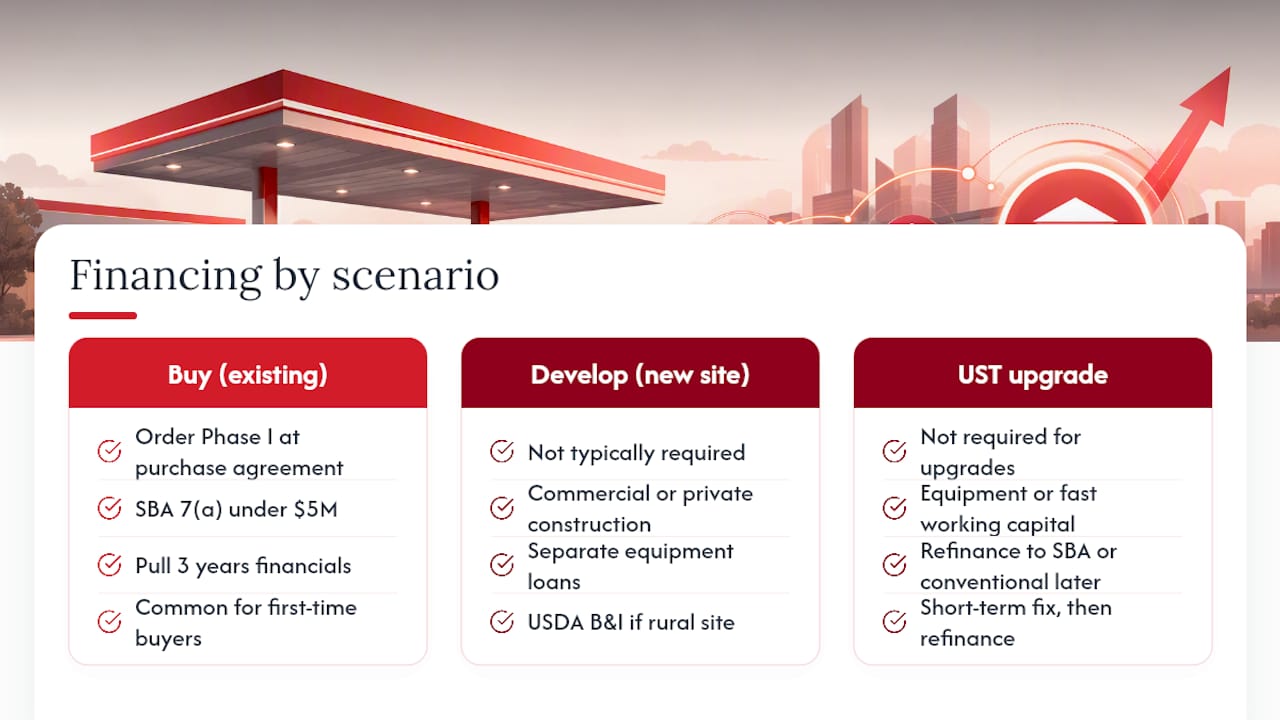
Buying an existing, operating station: order Phase I the day you sign the purchase agreement, pull three years of financials from the seller, and lean toward SBA 7(a) if the deal is under $5 million and you need to preserve cash. This is the most common path for first-time fuel retail buyers.
Developing a new site from the ground up: expect commercial construction financing or private construction capital, paired with separate equipment financing for pumps, canopies, and tank systems. USDA B&I only applies if the site sits in a qualifying rural community.
Funding UST replacement or compliance upgrades on an existing site: equipment financing or a fast working capital loan covers the urgent work, and refinancing into long-term SBA or conventional debt makes sense once the upgrade is complete and cash flow stabilizes.
What We See Most Often in Gas Station Deals
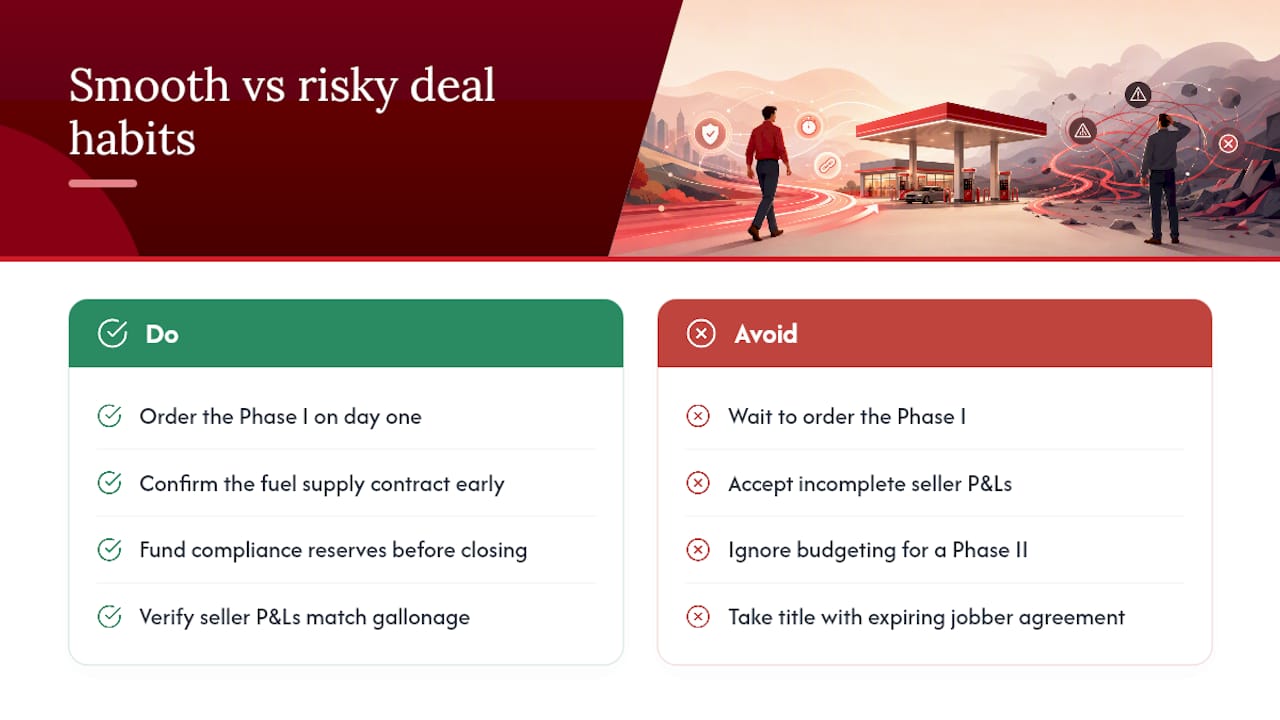
The deals that close smoothly all share one habit: the buyer orders the Phase I on day one, not after loan approval. Waiting costs weeks you don't get back.
The deals that die usually share different habits. Incomplete seller P&Ls that don't match reported fuel gallonage. A surprise Phase II that nobody budgeted for. Buyers who forgot that compliance reserves, not just the down payment, need to be funded before closing. Confirming the fuel supply contract early avoids a fourth common problem: a jobber agreement that expires right after you take title.
How Mayday Private Capital Can Help You Close
Bank underwriting on fuel sites can be rigid, and that rigidity is exactly where a private lender who reads the whole deal, not just a checklist, earns its keep. Mayday Private Capital offers nationwide private real estate financing built for investors who run into the gaps conventional banks won't cross: a flagged environmental report, a thin credit file, or a closing date that can't slip another month.
Mayday provides quick preliminary reviews so you know within days, not weeks, whether a deal is financeable, and bilingual support means the conversation happens in the language you're most comfortable negotiating in. If you're a first-time buyer working through loan programs designed for new investors and borrowers with credit challenges, or an established operator who needs a bridge while your SBA file finishes underwriting, Mayday's approach starts with understanding your deal's context rather than running it through a generic application form. Reach out through the Mayday contact page to walk through your specific gas station acquisition and get a preliminary read on financing structure.
Sources
For deeper detail on SBA underwriting rules and environmental due diligence, see the SBA 7(a) requirements guide, the step-by-step lending walkthrough, and lender product comparisons for fuel retailers.
This article is general information, not a substitute for advice from a qualified financial advisor. Consult a qualified financial professional about your own circumstances before acting on anything here.
- SBA 7(a) Loans for Gas Stations: Requirements & Rates (2026)
FAQ
How much down payment do I need for a gas station loan?
SBA 7(a) loans typically require a 10 to 15% equity injection, while conventional bank loans usually ask for 30 to 40% down on fuel sites.
Can I finance underground storage tank replacement separately?
Yes. Equipment financing is commonly used for UST and pump upgrades, using the equipment as collateral, and it can close faster than a full acquisition loan.
What's the best loan for a first-time gas station buyer?
SBA 7(a) is usually the practical choice for first-time buyers since it lowers the equity requirement compared with conventional bank financing, though private lenders like Mayday Private Capital can help bridge credit or timing gaps that don't fit standard bank criteria.
How long does gas station financing take to close?
SBA loans typically close in 30 to 90 days, conventional bank loans in 30 to 60 days, and private or seller financing can close in a few weeks, assuming Phase I comes back clean.
Does every gas station loan require an environmental assessment?
Nearly every SBA and institutional lender requires a Phase I Environmental Site Assessment to the ASTM E1527-21 standard before approving financing on a fuel site.