
Acquiring or refinancing a stabilized industrial building usually points to a conventional bank term loan, life-company loan, CMBS execution, or SBA 504 if you occupy the space. Ground-up construction calls for a construction or construction-to-permanent loan. Fast closings, credit challenges, or properties banks won't touch fit bridge loans or private money/DSCR financing. The right pick depends on loan size, property use, and your DSCR and experience profile, and firms like Mayday Private Capital exist specifically to fill the gaps traditional lenders leave open.
TL;DR:
- Conventional bank loans are best suited for stabilized, income-producing industrial properties, typically requiring strong sponsorship and two or more years of experience.
- Ground-up construction and major expansions are financed through construction loans, which disburse in milestones and usually convert to permanent financing after completion.
- Private money and DSCR loans are ideal for quick acquisitions, unconventional income streams, or properties with atypical documentation, accepting higher rates and lower leverage.
- Loan rates depend on risk structure, with conventional loans averaging 5-7.5%, bridge loans up to 12%, and construction loans from 6% to 10.5%, heavily influenced by credit and property specifics.
- Rapid closing and full documentation are crucial, with a typical 45 to 75-day timeline for traditional loans, while private and bridge loans can settle within two to four weeks if prepared early.
Table of Contents
- Industrial Property Financing Options: Bank Loans, SBA, Bridge, and More
- What Rates and Loan Terms Should You Expect?
- How Do Lenders Underwrite an Industrial Property Loan?
- Choosing the Right Loan: A Decision Framework
- Applying for Industrial Financing: Documents and Timeline
- How Mayday Private Capital Approaches Industrial Financing
- Why Underwriting Discipline Matters More Than Ever
- Ready to Finance Your Next Industrial Property?
- Sources
- FAQ
Industrial Property Financing Options: Bank Loans, SBA, Bridge, and More
Every industrial deal eventually forces the same question: which lender actually wants this loan? Banks, insurance companies, SBA-backed programs, and private lenders each chase a different risk profile, and matching your deal to the right channel saves months and real money.
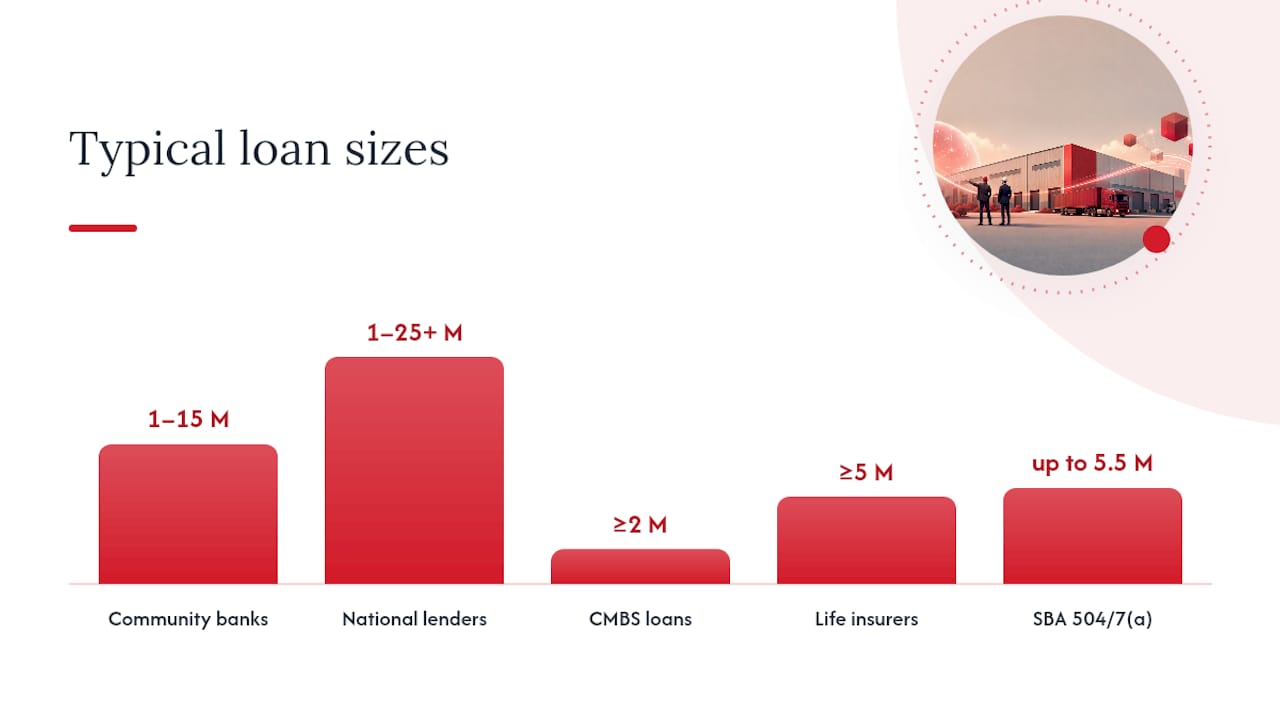
Conventional bank term loans remain the default for stabilized warehouses, flex buildings, and light manufacturing facilities with paying tenants. Community and regional banks typically lend $1 million to $15 million, with larger national and institutional lenders handling $1 million up to $25 million or more for stronger sponsors, according to JPMorgan's commercial term lending page. Expect full underwriting, personal guarantees on most deals, and a preference for borrowers with two or more years of ownership experience.
CMBS loans securitize your mortgage alongside dozens of others and sell it to bond investors. That structure buys you non-recourse debt and often a lower rate than a bank offers, but it comes with rigid loan documents, defeasance or yield-maintenance prepayment penalties, and a servicer who won't renegotiate anything mid-term. CMBS works best for larger, stabilized industrial assets, generally $2 million and up, where the borrower doesn't need flexibility later.
Life insurance company loans target the same stabilized asset class as CMBS but with a portfolio lender's judgment instead of a bond trustee's rulebook. Life companies favor institutional-quality distribution centers and manufacturing plants with long-term leases, and they'll usually beat bank pricing on loans above $5 million.
SBA 504 and 7(a) loans solve a different problem entirely: they're built for owner-occupiers, not investors. If your business will occupy at least 51% of the industrial space, SBA 504 delivers long-term, fixed-rate financing for the building and major equipment, with loan amounts up to $5 million (or $5.5 million for certain manufacturing and energy projects) through a Certified Development Company partnered with a bank. It is not built for speculative rental investment, and lenders will decline an application the moment the occupancy math doesn't work.
Bridge loans step in when timing matters more than rate. A distressed acquisition, a lease-up play, or a deal with a 30-day close deadline rarely survives conventional underwriting timelines. Bridge lenders close fast, often in two to four weeks, in exchange for a shorter term and a higher rate.
Construction loans fund ground-up industrial builds or major expansions, disbursing in draws tied to completion milestones, then typically converting to permanent financing or getting refinanced once the certificate of occupancy is issued.
Private money and DSCR loans fill the space banks won't enter quickly: fix-and-flip industrial conversions, properties with unconventional income, or borrowers whose tax returns don't reflect actual cash flow. These lenders trade higher rates and lower leverage for speed and flexibility investors sometimes can't get anywhere else.
Here's how the fit typically breaks down by scenario:
- Stabilized warehouse with strong tenants and $5M+ loan size: life company or CMBS
- Owner-occupied manufacturing facility under $5.5M: SBA 504
- Fast acquisition or credit-challenged borrower: private money loan
- Ground-up build or major expansion: construction-to-permanent loan
- Rental industrial property with unconventional documentation: DSCR loan
- Short-term gap between acquisition and permanent financing: bridge loan
What Rates and Loan Terms Should You Expect?
Industrial loan pricing tracks the risk of the structure, not just the property. A stabilized warehouse with a 10-year lease and a bank term loan sits in a completely different rate world than a raw-land construction draw.
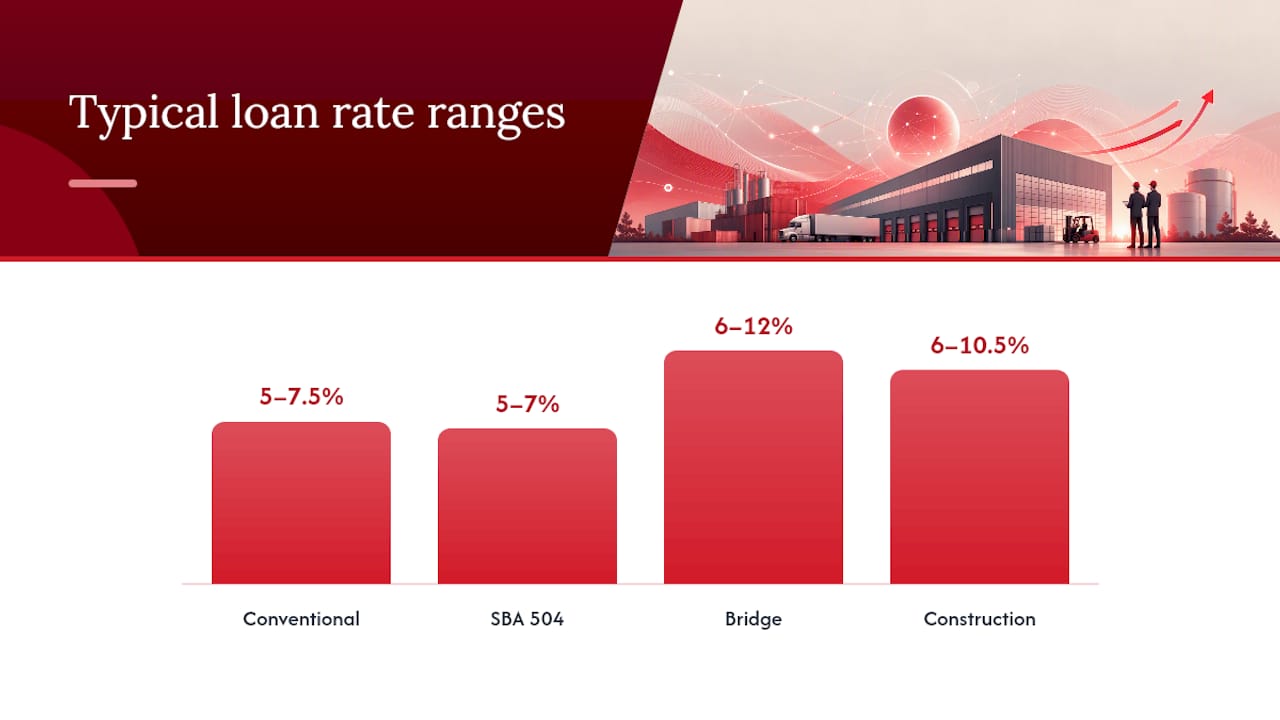
Statistic Callout: Conventional commercial loans currently run roughly between about 5% and 7.5%, SBA 504 loans around 5% to 7%, bridge loans between approximately 6% and 12%, and construction loans generally range from about 6% to 10.5%, according to NerdWallet's 2026 commercial real estate rate summary. Actual pricing depends heavily on your credit profile, the property's income history, and where the market sits when you lock.
Amortization structure matters as much as the headline rate. Bank term loans usually amortize over 20 to 25 years but carry a balloon payment at 5, 7, or 10 years, meaning you'll refinance again before the loan is paid off. SBA 504 loans fully amortize over 10, 20, or 25 years with no balloon, which is exactly why owner-occupiers who qualify tend to prefer them. Bridge and construction loans run short, typically 6 to 36 months, interest-only, with the expectation you'll refinance or sell before maturity.
Leverage expectations shift by loan type too:
- Conventional bank loans: commonly a moderate to high loan-to-value ratio for industrial properties
- SBA 504: can offer a high combined loan-to-value ratio for qualifying owner-occupied projects
- Bridge loans: typically a moderate loan-to-value ratio based on as-is or as-stabilized property value
- Private money/DSCR: loan-to-value ratios vary, often moderate but sometimes lower depending on property characteristics
Borrowers who bring a larger down payment, a stronger debt service coverage ratio, and a cleaner credit profile consistently get better pricing across every channel, and shopping the deal to more than one lender type often moves the rate more than any single negotiating tactic, per NerdWallet's analysis.
How Do Lenders Underwrite an Industrial Property Loan?
Lenders aren't guessing on industrial deals anymore. Federal supervisory guidance pushes banks toward tighter, better-documented underwriting for commercial real estate, and that discipline flows straight into what you'll be asked to prove before a loan gets approved, per FDIC guidance on commercial real estate lending.
- Debt service coverage ratio (DSCR). Most lenders want net operating income covering the mortgage payment by at least 1.20 to 1.25 times; industrial deals with single-tenant risk sometimes need closer to 1.35.
- Debt yield. Calculated as net operating income divided by loan amount, debt yield gives lenders a leverage check that doesn't move with interest rates the way DSCR does.
- Loan-to-value. Appraised value drives your maximum loan size, and industrial appraisals increasingly factor in functional obsolescence: low clear heights, outdated loading configurations, or insufficient trailer parking all pull value down.
- Rent roll and lease stability. Lenders scrutinize lease term remaining, tenant credit, and rollover exposure. A single-tenant building with three years left on the lease underwrites very differently than one with a 12-year investment-grade tenant.
- Environmental risk. A Phase I environmental site assessment is close to mandatory on industrial property given the sector's history with fuel storage, manufacturing runoff, and prior industrial use; a Phase II gets ordered the moment Phase I flags a concern.
- Sponsor track record and liquidity. First-time industrial buyers face more scrutiny than repeat sponsors, and lenders want to see post-closing liquidity, not just enough cash to fund the down payment.
- Entity structure and documentation. Expect to produce formation documents, operating agreements, personal financial statements, and two to three years of tax returns for every principal with meaningful ownership.
Pro Tip: Order your Phase I environmental report the same week you sign the letter of intent, not after your lender requests it. Environmental delays cause more blown closing timelines on industrial deals than any other single diligence item.
Choosing the Right Loan: A Decision Framework
The best financing choice isn't the cheapest rate on paper. It's the structure that matches how long you'll hold the asset, how much certainty you need, and how much friction you can tolerate before closing.
Start with these questions before you talk to a single lender:
- How long do you plan to hold this property, and does the loan term match that horizon?
- Is the space leased, vacant, or partially occupied, and how stable is that income?
- Will you need capital for improvements after closing, and does the loan structure allow for it?
- Can you tolerate a 60 to 90 day closing timeline, or do you need funding in weeks?
- Are you comfortable with a personal guarantee, or does non-recourse structuring matter more to you than rate?
Once you know your priorities, run every lender conversation through the same set of comparison questions:
- What's the prepayment penalty structure, and is there a rate lock fee?
- Is the loan recourse or non-recourse, and under what conditions does that change?
- What financial covenants apply during the loan term, and how are they tested?
- What's your realistic timeline from application to funding, given current volume?
- What are all origination, underwriting, and third-party report fees, itemized?
A few signals should push you toward bridge or private financing instead of waiting on a bank: a seller who needs a 21-day close, a property with deferred maintenance a bank appraiser will flag, or a borrower whose most recent tax return understates real cash flow. In any of those cases, delaying the acquisition to chase a marginally better bank rate usually costs more than the rate spread saves.
Applying for Industrial Financing: Documents and Timeline
Closing on time comes down to preparation, not luck. Lenders move at the speed of the slowest document in the file, so building the packet early is the single biggest lever you control.
- Assemble your document package before applying. Rent roll, current leases, two to three years of property financials, personal and entity tax returns, a personal financial statement, entity formation documents, and a purchase contract or refinance payoff statement all get requested eventually, so gather them up front. Mayday's Commercial Property Document Checklist breaks the full list down by document type.
- Order third-party reports immediately after signing the LOI. Appraisals typically take 3 to 4 weeks, Phase I environmental reports take 1 to 2 weeks, and surveys can take 2 to 3 weeks; ordering all three the same week saves real calendar time.
- Expect underwriting to run 2 to 4 weeks once the file is complete, longer if the rent roll needs verification calls or the appraisal comes in below the contract price.
- Budget 45 to 75 days total from signed application to funding for conventional and SBA loans; bridge and private money loans can close in 2 to 4 weeks when documentation is ready on day one.
- For SBA 504 specifically, work with your Certified Development Company early since CDC processing runs parallel to, not after, bank underwriting, and starting that conversation late is the most common cause of SBA closing delays.
How Mayday Private Capital Approaches Industrial Financing
Some private lenders review the whole deal, not just a credit score, which matters most when your industrial property doesn't fit a standard underwriting box. Certain lenders offer a preliminary review process aimed at first-time investors, borrowers with credit challenges, and Spanish-speaking clients to help them bid confidently on a competitive listing.
Products relevant to industrial investors include:
- DSCR loans for stabilized rental industrial assets
- Ground-up construction financing for new industrial builds
- Commercial real estate loans for broader mixed-use and commercial industrial deals
- Fix-and-flip loans for value-add industrial conversions
Mayday serves investors nationwide, including growing markets like Chicago, and pairs every product with plain-language guidance on structuring the deal correctly the first time.
Why Underwriting Discipline Matters More Than Ever
Regulators keep tightening how banks measure CRE concentration risk, and that discipline is trickling into every underwriting file, including industrial. Investors who assume last cycle's DSCR cushion is safe enough are wrong. Budget for a stress-tested DSCR, not a bare minimum, and weight your acquisitions toward buildings with modern clear heights and loading capacity. Functionally obsolete industrial space is getting harder, not easier, to finance.
— Angel
Ready to Finance Your Next Industrial Property?
Mayday Private Capital is the alternative to waiting on bank committee schedules and rigid box-checking: a private lender that reads your actual deal, not just your credit file, and gets you a preliminary answer fast enough to compete for a property with a tight closing window. Whether you're acquiring a stabilized warehouse, converting a light manufacturing building, or breaking ground on new industrial space, Mayday matches the structure to the deal instead of forcing the deal into one product.
If your project needs speed, flexibility on documentation, or bilingual support through the process, start with a DSCR loan review for stabilized rental income, a private money loan for a fast close, or explore commercial real estate loan options for a broader industrial or mixed-use deal. New investors and borrowers with past credit challenges can also review Mayday's loan programs built specifically for those situations. Ready to move forward? Apply now and get a preliminary answer on your industrial deal.
This article is general information, not a substitute for advice from a qualified financial advisor. Consult a qualified financial professional about your own circumstances before acting on anything here.
Sources
- 504 loans - Small Business Administration
- Commercial real estate lending | FDIC
- Commercial Real Estate Loan Rates for 2026 - NerdWallet
FAQ
What Is the Payment on a $1,000,000 Business Loan?
At rates between roughly 5% and 7.5% amortized over 20 to 25 years, monthly principal and interest payments vary by loan size; shorter terms or higher-rate bridge loans typically mean higher monthly payments, per NerdWallet's rate data.
What Is the 2% Rule in Commercial Real Estate?
The 2% rule suggests monthly rent should equal at least 2% of the property's purchase price to generate strong cash flow, though most industrial deals in competitive metros land well below that threshold and still work on a DSCR basis.
What Is the Interest Rate for Industrial Property Loans?
Rates vary by structure: conventional bank loans run about 5% to 7.5%, SBA 504 around 5% to 7%, bridge loans 6% to 12%, and construction loans 6% to 10.5%, according to NerdWallet.
Do DSCR Loans Require 20% Down?
DSCR lenders typically expect a moderate loan-to-value ratio that varies depending on the property's debt service coverage ratio and lender risk appetite; Mayday's DSCR loan program evaluates each deal individually rather than applying one fixed rule.