
Yes, non warrantable condo financing is possible, and it usually runs through a portfolio or non-QM lender, a local credit union, cash, or seller financing rather than a conventional agency loan. Expect a higher rate, a bigger down payment, and a smaller pool of lenders willing to write the loan. Sometimes the smarter move is waiting for the HOA to fix the problem, which can restore normal financing. Either way, pull the condo questionnaire and get at least two written quotes before you decide.
TL;DR:
- Non-warrantable condos are mainly financed through portfolio or private lenders, often with higher rates, larger down payments, and fewer lending options.
- Lenders consider project issues like low reserves, litigation, high investor ownership, or excessive commercial space, which can cause a condo to become non-warrantable.
- Waiting for the HOA to fix its financial or legal issues can restore eligibility and reduce borrowing costs if the timeline allows.
- Verifying warrantability requires reviewing HOA financials, litigation, and reserve studies before closing; recheck these documents shortly before settlement.
- Successful financing relies on clear communication with a lender that holds loans on its own books, and getting multiple written quotes helps compare costs accurately.
Table of Contents
- What Makes a Condo Non-Warrantable?
- Which Financing Routes Actually Work for Non-Warrantable Condos?
- What Do Non-Warrantable Condo Loans Cost?
- How Do You Verify a Condo's Warrantability Before You Close?
- How Should You Choose a Lender for a Non-Warrantable Condo?
- What Does the Closing Timeline Look Like?
- What Should Investors Actually Budget For?
- The One Question That Decides Everything
- How Mayday Private Capital Helps When Agency Financing Falls Through
- Where to Verify the Details Yourself
- Sources
- FAQ
What Makes a Condo Non-Warrantable?
Warrantability is a project-level label, not a judgment about you as a borrower. A condo project is "warrantable" when it meets the eligibility rules Fannie Mae and Freddie Mac use to buy loans from lenders. Fail those rules and the project is non-warrantable, even if your credit score is flawless and your down payment is generous, because the classification attaches to the building, not the buyer.
The triggers show up in the association's finances and legal history more often than in anything a unit owner controls:
- Reserve funds below what the project's age and repair needs call for
- Active or pending litigation involving the HOA
- Owner delinquency rates running high on HOA dues
- Commercial or retail space that eats up too much of the building's square footage
- One entity or investor owning too large a share of the units
- New-construction projects that haven't hit their required presale threshold
Agency underwriting on all of this has gotten stricter, not looser. Reserve requirements have climbed and some streamlined review paths have disappeared, so more buildings are landing in non-warrantable territory than a few years ago.
Which Financing Routes Actually Work for Non-Warrantable Condos?
Five paths show up repeatedly in real transactions, and each fits a different kind of buyer.
- Portfolio and non-QM lenders. These lenders keep the loan on their own books instead of selling it to Fannie Mae or Freddie Mac, so they set their own project rules. That flexibility is why portfolio and private lenders are the go-to source for non-warrantable financing when a project fails agency review. Rates run higher, but closings tend to move fast because there's no agency sign-off to wait on.
- Credit unions and community banks. A lender with a real relationship to the local market can sometimes underwrite around a project's quirks using compensating factors a national program would never consider. Availability is the catch. Not every credit union touches non-warrantable projects, and the ones that do often serve members or a defined footprint only.
- FHA single-unit approval and VA project review. These are agency programs with their own separate rulebooks, not blanket workarounds. FHA can sometimes approve an individual unit even when the broader project isn't approved, while VA financing typically still requires project-level approval, which limits how often either one actually helps.
- Cash. No lender, no project review, no rate premium. The tradeoff is obvious: your capital sits locked in one asset instead of working across multiple deals.
- Seller financing. Useful when a motivated seller wants out and a bank won't touch the building, though terms and rates are whatever the two of you negotiate.
A sixth option belongs on this list even though it isn't a loan: waiting for the HOA to cure the underlying problem. If the association rebuilds reserves or settles litigation, the project can requalify for conventional financing. If your timeline allows six to twelve months of patience, that's often the cheapest route on the whole list.
What Do Non-Warrantable Condo Loans Cost?
Non-agency pricing doesn't follow a published rate sheet the way conventional loans do. Each portfolio lender prices its own risk, so quotes for the same condo can vary meaningfully from one lender to the next.
A few patterns hold across most programs:
- Down payments commonly start higher than conventional minimums, and thin reserves, pending litigation, or high investor concentration in the building can push the required equity up further.
- Some non-warrantable programs cap loan-to-value around 80% to 85%, though the exact ceiling depends on the lender and the project's specific problems.
- Rates typically run above conventional pricing, reflecting the fact that the lender is holding the risk instead of passing it to an agency.
Statistic Callout: Reserve studies matter more than most buyers realize. A building funding reserves at only a fraction of what a professional study recommends is a strong predictor of a special assessment landing on owners within a few years, which changes your real carrying cost regardless of the mortgage rate you locked.
Run the math both ways before you commit: calculate total interest on the non-agency loan over your expected hold period, then compare it against the cost of waiting for an HOA cure and refinancing into a conventional loan later. Sometimes the premium rate is cheap insurance against losing the deal. Sometimes patience wins outright.
How Do You Verify a Condo's Warrantability Before You Close?
Ask the HOA for these documents before you remove a financing contingency:
- Current operating budget and the most recent reserve study
- Insurance certificates covering the building and common areas
- A delinquency report showing what percentage of owners are behind on dues
- Board meeting minutes from the past year or two
- The lender's condo questionnaire, fully completed by the association
A reserve study funded well below its target, or a delinquency report showing a double-digit percentage of units behind on payments, both point toward eligibility trouble. Litigation mentioned in the minutes is worth flagging even if it seems minor. A project's status can shift mid-transaction if new litigation surfaces or insurance lapses, so re-verify status right before closing rather than trusting a document pulled weeks earlier.
How Should You Choose a Lender for a Non-Warrantable Condo?
Start with one question: does this lender hold loans on its own books, or does it plan to sell the loan? Portfolio lenders are almost always the ones with the flexibility to say yes to a non-warrantable project in the first place.
Once you've confirmed that, push for specifics:
- Get a written quote listing rate, APR, required down payment, and any reserve requirements
- Ask whether prepayment penalties apply if you plan to refinance once the project cures
- Ask how the lender treats pending litigation, investor concentration, or short-term rental income documentation
- Ask directly whether the loan can be refinanced into conventional terms if the building becomes warrantable later
Pro Tip: Vague answers about underwriting exceptions, or a lender that won't commit terms to writing before you apply, are red flags. A lender confident in its own guidelines will tell you exactly what it can and can't approve.
What Does the Closing Timeline Look Like?
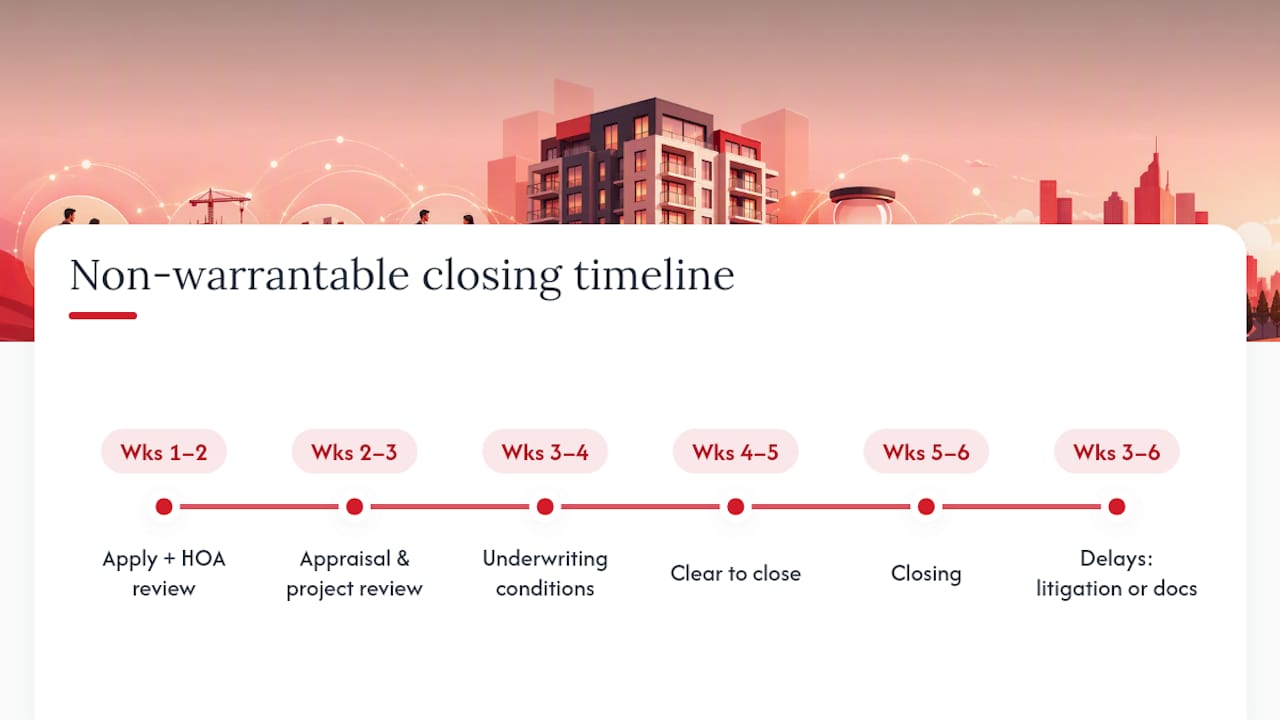
Non-warrantable condo financing usually takes longer than a standard conventional purchase, mostly because of the extra project-level paperwork.
Weeks 1 to 2: You submit a loan application along with the HOA questionnaire, budget, and reserve study. The lender's underwriting team reviews the project files alongside your personal financial documents.
Weeks 2 to 3: The lender orders an appraisal and runs its project review in parallel. This is where portfolio lenders often move faster than agency-backed processes, since there's no secondary review from Fannie Mae or Freddie Mac to wait on.
Weeks 3 to 4: Underwriting issues conditions, which commonly include updated HOA financials, clarification on any litigation, or additional reserve documentation from the association. This step is where non-warrantable deals most often stall, so respond to condition requests immediately.
Weeks 4 to 5: Clear to close. Final HOA questionnaire confirmation happens again here, since status can shift between application and closing.
Weeks 5 to 6: Closing. Total timeline for most non-warrantable deals runs somewhere in the five to seven week range, though a lender already familiar with the project or a straightforward reserve study can close faster. A building with active litigation or missing HOA documentation can stretch well past that.
What Should Investors Actually Budget For?
Three cost categories deserve attention beyond the interest rate quoted on the loan estimate.
Down payment. Plan for a larger equity requirement than a conventional loan would demand. A project with strong reserves and no litigation might only push your down payment modestly higher, while a project with real red flags can require substantially more equity to offset the lender's risk.
Rate premium. Non-agency pricing for these loans typically runs above conventional rates, since the lender is pricing project risk it can't offload to an agency. The exact spread depends entirely on the lender and the individual condo's file.
Fees and reserves. Beyond origination fees, expect the lender to require larger post-closing cash reserves than a conventional loan would, sometimes six to twelve months of payments held in reserve. Add HOA-required reserve contributions on top of your mortgage payment, and factor in the real possibility of a special assessment if the building's reserve study shows a shortfall.
None of these numbers are fixed across the industry. Portfolio lender pricing and terms vary widely by institution, which is exactly why getting multiple written quotes matters more here than on a standard mortgage.
The One Question That Decides Everything
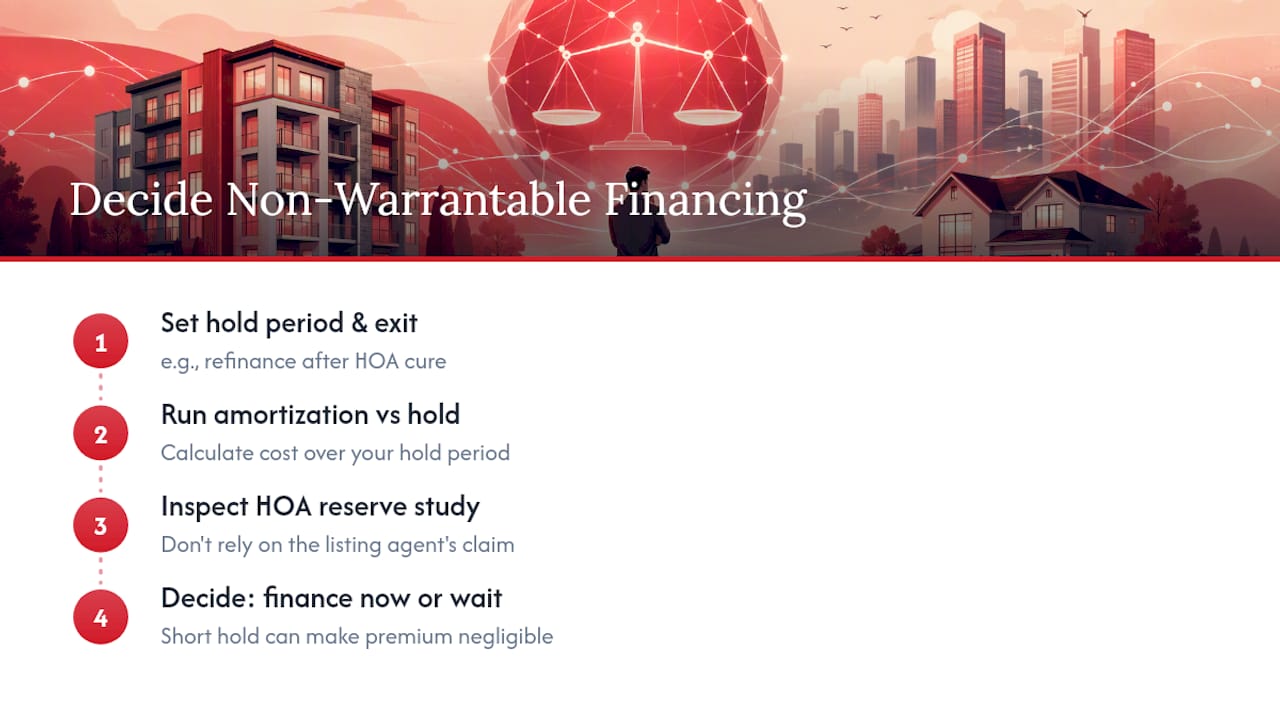
Every non-warrantable financing decision comes down to how long you plan to hold the property and how you plan to exit. A rate premium that looks expensive on a thirty-year amortization schedule can be almost irrelevant if you're refinancing in eighteen months once the HOA cures its reserve shortfall. Run the actual amortization numbers against your hold period, not against the sticker rate. Check the reserve study yourself instead of taking a listing agent's word for it.
— Angel
How Mayday Private Capital Helps When Agency Financing Falls Through
There are lenders who specialize in financing projects that fail agency review when conventional lenders walk away. Where big banks see a declined file, Mayday looks at the actual deal: the reserve study, the litigation context, your exit plan, and the property's real numbers.
The firm's private money loans are built for exactly this scenario, since they're held by the lender rather than sold to an agency, which is what makes non-warrantable approval possible in the first place. Investors planning to rent the unit long-term often use DSCR loans that qualify off rental income instead of a W-2. Buyers targeting a unit that needs work before it can be rented or resold can look at fix-and-flip loans instead. Mayday lends across all 50 states and offers bilingual support in English and Spanish, with quick preliminary reviews so you know where you stand before you commit to a project with a complicated HOA file. If you're staring down a non-warrantable condo and a wall of "no" from conventional lenders, request a preliminary review and get real terms in writing.
Where to Verify the Details Yourself
Check project-level FHA eligibility directly through the HUD condominium lookup. Confirm any lender's licensing through NMLS Consumer Access before signing anything. For context on how agency rules keep shifting, CNBC's coverage of the Fannie Mae and Freddie Mac condo rule changes is worth a read.
Sources
- Non-Warrantable Condo Financing: Every Route Compared | The HOA Guide
- The Complete Guide To Nonwarrantable Condo Financing | Lower Mortgage
- Condo buyers face new mortgage rules under Fannie Mae, Freddie Mac | CNBC
FAQ
Can You Finance a Non-Warrantable Condo?
Yes. Portfolio and non-QM lenders are the most common route, since they hold the loan themselves instead of selling it to an agency, which lets them set their own project standards. Credit unions, cash, and seller financing are the other realistic paths.
Is It a Bad Idea to Buy a Non-Warrantable Condo?
Not automatically, but it comes with real tradeoffs: a smaller resale buyer pool, a higher rate on your loan, and exposure to special assessments if the building's reserves are thin. Investors with a clear exit plan and a realistic hold period can still make the numbers work, especially if the HOA is actively fixing the issue that caused the classification.
What Are the Current Interest Rates for Non-Warrantable Condo Loans?
Rates vary by lender since each portfolio lender prices its own project risk rather than following a published agency rate sheet. Getting written quotes from at least two lenders is the only reliable way to know what you'll actually pay.
How Do I Find Out if a Condo Is Non-Warrantable?
Request the HOA's condo questionnaire, reserve study, budget, and delinquency report, then have your lender run the project through its review. You can also check HUD's condominium lookup directly for FHA-specific eligibility, and re-verify status close to closing since a project's standing can change mid-transaction.