
Yes, you can finance self-storage through several established routes, and the right one depends entirely on your deal profile. Stabilized facilities with clean occupancy history fit conventional bank debt or CMBS. Ground-up construction and owner-operator purchases lean on SBA 7(a) or 504. Lease-up and value-add deals need bridge or private debt, and plenty of independent sellers will still carry a note themselves.
TL;DR:
- Conventional bank and CMBS loans are best for stabilized properties, with LTVs of 65% to 75%, while SBA loans require only 10% to 20% down for owner-operators.
- Bridge and private debt are suitable for lease-up or value-add deals, offering quick closings within 2 to 4 weeks, but with higher rates and shorter terms.
- Seller financing is common for off-market deals, typically involving 10% to 20% down, interest-only notes, and a 5-year balloon, requiring proper legal documentation.
- Loan approval heavily depends on DSCR (usually 1.20 to 1.30), occupancy history, and cash flow, with lender underwriting prioritizing actual income over projected lease-ups.
- Rates are influenced by the loan type and rate environment, with fixed-rate options providing security and variable-rate loans exposing borrowers to future rate increases.
Table of Contents
- What Are the Main Self Storage Financing Options?
- How Does SBA Financing Work for Storage Facilities?
- What Terms Do Banks and Credit Unions Offer?
- Is CMBS Lending a Good Fit for Stabilized Storage?
- When Should You Use Bridge or Private Debt?
- How Does Seller Financing Work for Storage Deals?
- How Do Lenders Underwrite a Self-Storage Loan?
- How Do You Decide Which Financing Route to Pursue?
- Mayday Private Capital's Approach to Storage Investors
- How Much Does Your Credit Score Actually Matter?
- What Makes a Loan Application Package Actually Compelling?
- What Pitfalls Trip Up First-Time Storage Borrowers?
- What Role Do Guarantors and Co-Signers Play?
- How Do Interest Rate Trends Affect Storage Financing Costs?
- Where to Start If You're Financing a Storage Deal
- How Mayday Can Help You Finance Your Next Storage Deal
- Sources
- FAQ
What Are the Main Self Storage Financing Options?
Every deal has a natural lender match, and matching it correctly saves weeks of wasted underwriting. Storage benefits from unusually stable cash flow characteristics, which gives operators more lender variety than most commercial asset classes get, though it's worth noting there's no agency channel (no Fannie Mae or Freddie Mac program) for storage the way there is for multifamily.
- Banks/credit unions: best for stabilized or near-stabilized assets, 65% to 75% LTV, recourse debt, 5 to 10 year terms with 20 to 25 year amortization.
- SBA 7(a)/504: best for owner-operators with limited cash, 10% to 20% down, longer approval timelines (60 to 90 days), often full recourse via personal guaranty.
- CMBS/conduit: best for large, stabilized loans ($3 million-plus), non-recourse, fixed rate, strict prepayment penalties.
- Bridge/private debt: best for lease-up or renovation, 6 to 24 month terms, higher rates, fast closings (2 to 4 weeks).
- Seller financing: best for off-market deals with a motivated, debt-free seller, flexible terms, minimal underwriting friction.
Speed, price, and paperwork trade off against each other in a predictable way. Bank and SBA debt costs less, but takes longer and demands more documents. Bridge capital costs more but closes fast with a lighter file.
How Does SBA Financing Work for Storage Facilities?
SBA 7(a) and 504 loans exist specifically to help smaller operators buy real estate without the 25% to 35% down payment conventional lenders often demand. SBA 7(a) is the more flexible of the two: it can finance acquisition, construction, equipment, and working capital in a single loan, up to a maximum of $5 million. Amortization typically runs 25 years on the real estate portion, and for many first-time buyers it's the only realistic path to 10% to 15% down instead of the 20% to 35% conventional lenders require.
SBA 504 works differently. A bank funds a first mortgage, and a Certified Development Company funds a second loan covering up to 40% of the project, which typically requires 10% to 20% borrower equity. That structure fits purchase-plus-expansion deals or long-term fixed-rate debt on a stabilized facility.
- 7(a) construction-to-perm: single closing, one set of costs, useful for smaller ground-up projects.
- 504: better rate on the CDC piece, but two closings and more coordination.
- Both carry a personal guaranty requirement and a 60 to 90 day closing window, sometimes longer for new construction.
What Terms Do Banks and Credit Unions Offer?
Conventional bank debt remains the default for stabilized storage facilities with a track record. Expect 65% to 75% LTV, 20% to 30% down payment, and 20 to 25 year amortization with a balloon or rate reset at 5, 7, or 10 years. Most community banks size the loan off DSCR rather than raw LTV, and they'll want to see at least two years of clean rent roll history before they get comfortable.
Smaller storage loans, particularly under $2 million, usually carry full or partial recourse, meaning your personal guaranty backs the note. Local banks and credit unions also tend to negotiate on rate and reset length more than larger institutions, especially if you already bank with them.
Pro Tip: Walk into the bank with a one-page deal summary showing purchase price, in-place NOI, and DSCR before you ever ask for term sheets. Lenders move faster when they don't have to build the numbers themselves.
Is CMBS Lending a Good Fit for Stabilized Storage?
CMBS debt makes sense once a facility is fully stabilized and the loan size clears roughly $3 million, since conduit lenders bundle loans into securitized pools and want scale. The appeal is real: non-recourse structure and long-term fixed rates, often 10-year terms with interest-only periods that conventional banks rarely offer.
The catch shows up at exit. CMBS loans carry strict servicing requirements and expensive defeasance penalties if you want to sell or refinance before maturity. That inflexibility is fine for a buy-and-hold investor planning to own the asset for a decade. It's a costly mistake for anyone who might need to sell in year three.
When Should You Use Bridge or Private Debt?
Bridge and private lenders fill the gap banks won't touch: a facility mid-lease-up, a value-add renovation, or a purchase that needs to close in three weeks, not three months. Expect 6 to 24 month terms, rates well above conventional bank debt, and interest-only structures with covenants tied to occupancy milestones rather than trailing financials.
The entire point of bridge capital is to buy time, so lenders expect a credible refinance plan before they'll fund. Document your projected stabilized occupancy, expected NOI at stabilization, and the specific permanent lender you intend to refinance with. Mezzanine or subordinated debt occasionally layers on top of a bridge loan when the sponsor needs to stretch leverage beyond what the first mortgage lender allows, but it adds cost and complexity that only make sense on larger deals with real equity cushion.
How Does Seller Financing Work for Storage Deals?
Seller financing shows up in self-storage more than in almost any other commercial asset class, mostly because so many facilities are still owned free-and-clear by independent operators who built them decades ago. Always ask, even when it's not advertised.
Typical structures run 10% to 20% down with an interest-only or partially amortizing note and a 5-year balloon payment. Two things make seller financing safe rather than risky: a real estate attorney drafting the note and deed of trust, and a firm plan for refinancing before that balloon comes due.
How Do Lenders Underwrite a Self-Storage Loan?
Lenders size storage loans off cash flow first, LTV second. Two numbers decide how much you'll actually be able to borrow.
- Debt Service Coverage Ratio (DSCR): net operating income divided by annual debt payments. Most lenders want a floor of 1.20 to 1.30.
- Debt yield: NOI divided by loan amount, with lenders typically targeting 8% to 10%.
- Occupancy history: lenders underwrite in-place occupancy conservatively rather than trusting a pro forma lease-up projection, especially on newer facilities.
A quick example: say a facility generates $280,000 in NOI. At a 1.25 DSCR floor and a 7% rate on a 25-year amortization, the maximum loan the cash flow supports is roughly $2.8 million, even if 70% LTV on the purchase price would technically allow $3.4 million. DSCR becomes the binding constraint, not the headline leverage number.
Lenders will ask for personal tax returns, a trailing 12-month P&L (T12), a current rent roll, a market study, and, for construction loans, your general contractor's qualifications and a full commercial property document checklist.
How Do You Decide Which Financing Route to Pursue?
Match your deal profile to a lender type before you shop rates, or you'll waste weeks chasing the wrong quote.
- Stabilized asset, long hold: target a bank or credit union first, CMBS if the loan clears $3 million.
- Lease-up or value-add: target bridge or private debt with a clear refinance exit documented up front.
- Owner-operator with limited cash: target SBA 7(a) or 504, budgeting 60 to 90 days for approval.
- Off-market deal, motivated seller: ask directly about seller financing before assuming it's off the table.
Ask every prospective lender three things: What's the reset or balloon timeline? What's the prepayment penalty structure? What triggers a rate lock. Negotiate term length and reset timing harder than you negotiate rate; a bad reset schedule costs more over ten years than half a point on the note.
Pro Tip: Run your DSCR before you call a single lender. A deal that pencils at 1.15 DSCR needs a different game plan than one at 1.35, and knowing which one you have changes every conversation that follows.
Mayday Private Capital's Approach to Storage Investors
Mayday Private Capital works with real estate investors who don't fit the standard bank mold, including first-time buyers, operators with credit challenges, or anyone facing a tight closing window on a construction-to-perm build. Rather than running a checklist against your credit score, Mayday reviews the full context of the deal, then walks through DSCR-based financing, private money, or ground-up construction options that match it, with bilingual support available throughout.
How Much Does Your Credit Score Actually Matter?
Credit score shapes which lenders will even talk to you before it shapes your rate. Banks and SBA lenders typically want a personal FICO score above 680, and anything below 650 tends to knock out conventional and SBA options entirely, regardless of how strong the deal itself looks. Bridge and private lenders sit at the other end of that spectrum. They still check credit, but they weight the asset's cash flow and your exit plan more heavily than a three-digit number.
Your personal financial profile matters beyond the score itself. Lenders review personal tax returns, liquidity (cash reserves after closing), and existing debt obligations, because most storage loans under $2 million carry a personal guaranty. A borrower with a 720 score but thin cash reserves can actually underwrite worse than a 650 score borrower sitting on six months of reserves.
Past bankruptcies, foreclosures, or a string of late payments don't automatically disqualify you from private or bridge financing the way they do with a bank. What changes is pricing and leverage: expect a lower LTV and a higher rate to offset the risk a bank simply won't take on at all. If your credit history is uneven, lead with the deal's strength (NOI, occupancy, location) rather than leading with an explanation of your credit. Lenders who specialize in flexible underwriting want to see the asset can carry the debt first, and your credit story becomes a secondary conversation instead of a gatekeeping one.
What Makes a Loan Application Package Actually Compelling?
Most loan applications get slowed down by the same missing pieces, not by the deal itself. A package that anticipates every question a lender will ask moves through underwriting in days instead of weeks.
Start with the trailing 12-month P&L and a current, dated rent roll, both formatted cleanly rather than pulled raw from your property management software. Add two to three years of personal tax returns, a personal financial statement listing assets and liabilities, and a short written summary of your investment strategy for the property: hold, refinance, or eventual sale.
For construction or expansion loans, include your general contractor's license, a signed construction contract, and a detailed cost breakdown by trade. Lenders read a vague budget line ("construction: $1.2 million") as a red flag, while a line-itemed budget signals you actually understand your project.
A short market summary helps more than most borrowers expect. Two or three sentences on local population growth, competing facilities within a five-mile radius, and current occupancy at comparable properties tells a lender you've done real diligence, not just run the numbers on a spreadsheet.
Pro Tip: Build your package before you approach a single lender, not after the first one asks for something you don't have. A complete file on day one signals a serious borrower and often shaves a week or more off closing.
Finally, be upfront about anything imperfect in your file, whether it's a dip in occupancy last year or a personal credit issue from several years back. Lenders who specialize in flexible underwriting can usually work around a known issue explained clearly. They rarely forgive one they discover themselves halfway through the file review.
What Pitfalls Trip Up First-Time Storage Borrowers?
The single most common mistake is chasing LTV instead of DSCR. Run your DSCR before you fall in love with a purchase price.

Underestimating timeline is the second recurring problem. SBA loans routinely take 60 to 90 days, sometimes longer for new construction, and borrowers who sign a purchase contract with a 30-day close end up scrambling for a bridge loan just to make the closing date. Match your contract timeline to your actual financing timeline from the start, not after you've already signed.
Skipping the market study is a mistake that surfaces late and expensively. Lenders want to see local competition and population trends, and a borrower who shows up without one gets sent back to gather it, adding two or three weeks to underwriting.
Undercapitalizing the renovation or construction budget causes real damage. Contractors run over budget more often than not, and a borrower who financed exactly the estimated cost with no contingency ends up stuck mid-project when costs run 15% over projection.
Finally, treating seller financing casually costs some buyers dearly. A handshake note with no attorney and no refinance plan can turn into a forced sale when the balloon comes due and no lender is lined up to take it out. Paper it properly, every time.
What Role Do Guarantors and Co-Signers Play?
Most storage loans under roughly $2 million to $3 million carry some form of personal guaranty, meaning you, or a guarantor you bring in, are personally on the hook if the property's cash flow falls short. A guarantor with strong income, low existing debt, and clean credit can materially change what a lender is willing to offer, sometimes pushing approval through when the primary borrower's file alone wouldn't clear it.
Bringing in a co-signer or guarantor makes the most sense in a few specific situations: a first-time investor with limited real estate experience, a borrower whose personal credit took a hit but has a financially strong business partner, or a deal where the requested loan amount sits right at the edge of what the primary borrower's financials support alone. Lenders will underwrite the guarantor's full financial picture, tax returns, liquidity, and existing debt included, the same way they underwrite the primary borrower.
The trade-off is real: adding a guarantor means sharing legal liability with another person, and it usually means sharing some level of decision-making control over the property too. Put the guaranty terms in writing before closing, including exactly what happens if the loan goes into default, so nobody is surprised later. On larger CMBS and stabilized bank loans, non-recourse structures sometimes eliminate the personal guaranty requirement entirely, which is one more reason stabilized, well-documented deals attract better loan terms across the board.
How Do Interest Rate Trends Affect Storage Financing Costs?
Rate movement changes the math on every financing route differently, and understanding which loans are exposed the most helps you time your financing decision. Fixed-rate CMBS and SBA loans lock in a rate at closing, insulating you from future increases but also meaning you're stuck with today's rate even if rates fall later. Bank loans with a 5 or 7 year reset expose you to rate risk down the road, since your payment resets to whatever the market rate is at that point.
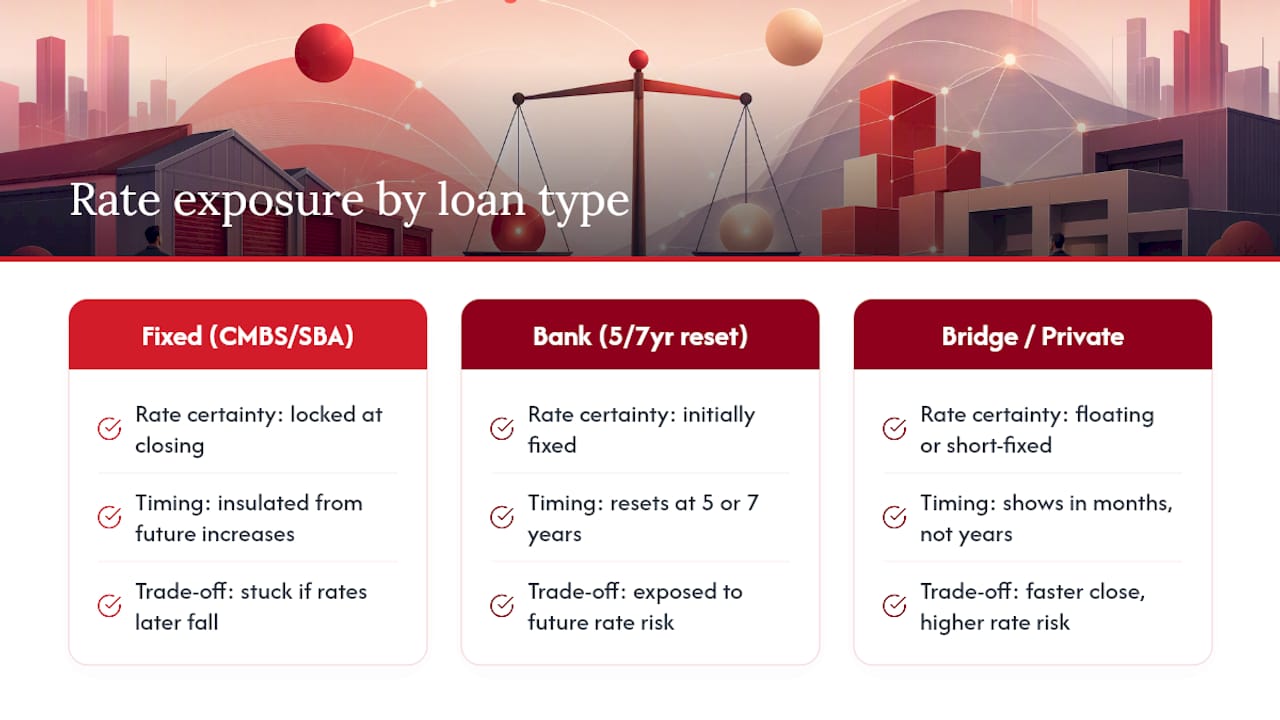
Bridge and private debt tend to carry floating or short-fixed rates tied to a benchmark, so a rate environment shift shows up in your carrying cost within a matter of months, not years. That's the trade-off for speed and flexible underwriting: you're taking on rate risk in exchange for a lender who doesn't need three months to close.
Rising rates compress DSCR directly, since a higher rate means higher debt service against the same NOI. If you're underwriting a deal today, stress-test it against a rate a point or two above current pricing before you commit. It's the cheapest insurance you'll buy in the entire process.
Where to Start If You're Financing a Storage Deal
If you're a stabilized owner, run your DSCR and pre-market to a bank and an SBA lender in the same week. If you're chasing speed or a value-add play, go straight to bridge or private debt and build your refinance exit before you sign anything. Either way, negotiate reset length as hard as rate.
— Angel
How Mayday Can Help You Finance Your Next Storage Deal
Mayday Private Capital is a direct route to flexible capital when a bank tells you no, or tells you yes but not fast enough. Instead of processing your file against a rigid checklist, Mayday looks at the whole deal, credit challenges, tight closing windows, and unconventional capital stacks included, and works through what actually fits.

Storage investors use Mayday for several situations covered in this guide: DSCR loans for cash-flowing acquisitions where the property's income carries the underwriting, private money loans for speed on off-market purchases, fix-and-flip loans for renovation-heavy value-add plays, and ground-up construction financing for new builds. Mayday provides bilingual support available for English and Spanish speaking borrowers.
Before you approach any lender, run the numbers with a rental cash flow calculator to get a realistic DSCR estimate, or use Mayday's own DSCR calculator to see what your deal supports. If your file is ready or close to it, start an application and get a preliminary review back quickly, whether you're a first-time buyer, an operator with past credit issues, or an experienced investor scaling a portfolio.
This article is general information, not a substitute for advice from a qualified financial advisor. Consult a qualified financial professional about your own circumstances before acting on anything here.
FAQ
How Do You Get Financing to Buy a Storage Facility?
Start by running DSCR and debt yield on the facility's trailing 12-month financials, since that determines your real borrowing capacity before LTV even enters the conversation. From there, match the deal to a lender type: banks or CMBS for stabilized assets, SBA for owner-operators, and bridge or private lenders like Mayday for speed or value-add situations.
Will the SBA Give a Loan for a Self-Storage Unit?
Yes, the SBA finances self-storage facilities through both the 7(a) and 504 programs, provided the property meets owner-operator eligibility requirements. SBA 7(a) tops out at $5 million and can bundle purchase, construction, and working capital into one loan.
What Are the Requirements to Qualify for an SBA 504 Loan?
SBA 504 requires a borrower equity contribution of 10% to 20%, a qualifying small business use of the property, and a bank willing to fund the first mortgage alongside the CDC's second loan. The property must also meet job creation or public policy goals the SBA sets for 504 eligibility.
Is There a Self-Storage ETF?
There isn't a self-storage specific ETF, but publicly traded self-storage REITs exist and are often held within broader real estate or REIT-focused ETFs. Direct facility ownership and financing, the focus of this guide, remains a separate path entirely from public REIT investing.
What Credit Score Do You Need for Self-Storage Financing?
Banks and SBA lenders typically look for a personal credit score above 680, while bridge and private lenders weigh the deal's cash flow and exit plan more heavily than the score itself. A lower score usually means a lower LTV and higher rate rather than an automatic decline, particularly with flexible lenders like Mayday.