

Transactional funding for real estate investors means private financing, DSCR loans, private money, bridge loans, or construction loans, used to acquire, rehab, hold, or build income property when a conventional mortgage won't close the deal in time or won't qualify it at all. It fits when the exit is clear: rent that supports a refinance, a rehab budget with a sale date, or a build with a permanent takeout lined up. If the numbers don't pencil against those exits, the deal isn't ready for this kind of capital yet.
TL;DR:
- Private money costs between 9% and 14% annually plus 1 to 3 points, with first-position loans offering better pricing than second-position funding.
- DSCR loans typically close in 21 to 28 days but require stabilized rent ratios of at least 1.00, with higher FICO scores unlocking better rates.
- Borrowers should align each funding type with the deal's exit plan, such as using bridge for rehab and private or DSCR for refinancing.
- Confirm lien position, rent figures, and property condition early, as delays in documentation or title issues can extend closing times significantly.
- The rate on private financing is less critical than modeling your refinance DSCR with conservative, appraiser-supported rent estimates before closing.
Table of Contents
- What Are the Main Types of Transactional Funding?
- When Should You Use Each Type of Financing?
- What Do Rates, Points, and LTV Typically Look Like?
- What Documents Do You Need to Apply?
- How Long Does the Transactional Loan Process Take?
- What Risks and Red Flags Should Investors Watch?
- Why Most Investors Overthink the Rate and Underthink the Exit
- Get Flexible Financing Built Around Your Deal, Not a Checklist
- Sources
- FAQ
What Are the Main Types of Transactional Funding?
Four products cover most investor scenarios, and each solves a different problem.
DSCR loans underwrite the property, not the borrower. The lender divides gross monthly rent by the monthly mortgage payment, including taxes, insurance, and association dues, to get a debt service coverage ratio. Standard programs want that ratio at 1.00 or higher for the best pricing, and there's no W-2 or tax return review involved, according to mbanc's DSCR guide.
Private money is relationship-based capital, often sourced from individuals or small funds rather than institutions, and priced to the specific deal rather than a rate sheet. Lien position drives the price: first-position private money can undercut hard money on rate, while second-position gap funding costs more, per RealEstateSkills' breakdown of private money costs.
Bridge and rehab loans cover short holding periods with draws released as work completes, built for properties that aren't rent-ready yet.
Construction loans fund ground-up builds in stages tied to inspections, with a permanent loan waiting at the finish line.
- DSCR: cheapest of the four, slowest to close, requires stabilized rent
- Private money: fast, flexible, priced by lien position and relationship
- Bridge/rehab: built for value-add timelines, draw-based
- Construction: staged funding, requires a takeout plan before the first draw
When Should You Use Each Type of Financing?
Matching the loan to the deal's exit strategy matters more than chasing the lowest rate.
- BRRRR deals need a two-step plan: rehab and lease-up funded by bridge or private money, then a DSCR refinance once the property is tenanted at market rent. Model that refinance DSCR before you buy, not after. A stabilized rehab commonly lands in the 1.00 to 1.20 DSCR range once an appraiser confirms market rent, which is usually enough to qualify for a permanent DSCR refinance.
- Fix-and-flip deals rarely qualify for DSCR at all, since there's no stabilized rent. Speed matters more than rate here, which is why hard money and private money dominate this lane.
- Buy-and-hold acquisitions on rent-ready properties often go straight to DSCR, or bridge-to-perm when the seller needs a fast close and you refinance shortly after.
- Construction projects need staged draws tied to completed work, plus a permanent loan already lined up before the first foundation pour.
What Do Rates, Points, and LTV Typically Look Like?
Pricing splits sharply by product, and lien position swings private money costs more than almost any other variable.
Private money in 2026 typically runs 9% to 14% annually plus 1 to 3 points, with terms of 6 to 24 months, and first-position loans price meaningfully better than second-position gap funding, according to RealEstateSkills. DSCR programs vary by file type: standard files with strong DSCR ratios get the best pricing, while no-ratio or low-DSCR files push rates up and LTV down.
- FICO floors typically range from 620 to 720-plus, with stronger credit unlocking better pricing
- DSCR program windows commonly run 0.75 to 1.25, and anything under 1.00 usually means a lower LTV
- Purchase LTVs generally fall between 70% and 80% depending on DSCR strength
- Reserve requirements range from 2 to 12 months of PITIA depending on the file's risk profile
These parameters come from DSCR Authority's 2026 qualification checklist, and they shift with amortization structure too: a 30-year fixed produces a lower payment and higher DSCR than an ARM at the same rate, which can be the difference between qualifying and not.
A complete DSCR file closes in roughly 21 to 28 days. Short-term rental income analysis or condo project reviews add time on top of that baseline, a point worth remembering before you write a tight closing date into a purchase contract.
What Documents Do You Need to Apply?
A complete file the first time you submit it is the single biggest lever you control over your own timeline.
- Credit report and score, since stronger FICO improves both rate and LTV
- LLC formation documents, operating agreement, and EIN, plus a personal guarantee on most 1 to 4 unit investor loans
- Signed lease, Form 1007 rent comparables, or a rent roll for multi-unit and portfolio deals
- Short-term rental income statements if the exit strategy depends on nightly rental revenue
- Proof of reserves covering several months of PITIA, plus a homeowner's insurance quote
- Condo or HOA packet if the property sits inside an association, since project reviews add processing time
Private money structures also require a promissory note, a recorded mortgage or deed of trust, and title insurance protecting the lender's lien position, standard documentation regardless of loan size. A few programs waive seasoning requirements on cash-out refinances, and foreign national borrowers should expect additional documentation around income verification and entity structure before submitting.
How Long Does the Transactional Loan Process Take?
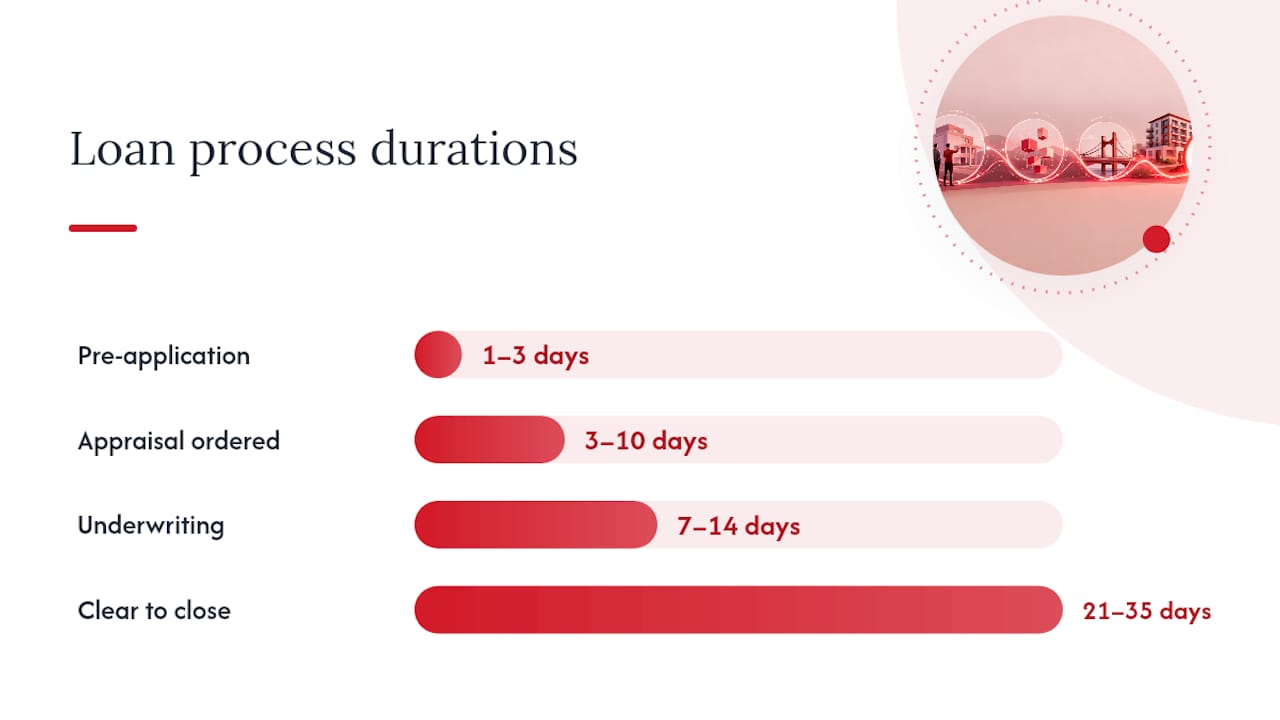
Most complete DSCR files move through four stages, and knowing what happens at each one lets you spot delays before they cost you a closing date.
- Pre-application (1 to 3 days): gather rent figures, tax and insurance estimates, and target rate and LTV before you submit anything.
- Appraisal ordered (3 to 10 days): the appraiser confirms property value and, for DSCR files, market rent.
- Underwriting (7 to 14 days): the lender reviews income documentation, entity paperwork, and reserves.
- Clear to close (total 21 to 35 days): title work finalizes and funds get scheduled to disburse.
Condo and HOA reviews, short-term rental income analysis, and staged construction draws all add business days on top of that range. Submitting a complete package upfront, using conservative rent figures instead of optimistic ones, ordering the HOA questionnaire early, and clearing title issues before you're under contract all shrink the timeline meaningfully.
Pro Tip: On your first call with any lender, ask three things: what DSCR threshold they need for your target LTV, whether they underwrite in-house or sell to a table-funder, and what specifically triggers a re-appraisal or rate lock extension. The answers tell you more about the loan than the rate sheet does.
What Risks and Red Flags Should Investors Watch?
The riskiest mistake in this asset class isn't a bad rate. It's holding expensive capital past its intended exit window.
- Second-position private money held longer than planned compounds the cost-of-time problem, since stacking a second lien behind hard money increases total carry cost fast
- Confirm lien position and title status before closing, not after, to avoid repayment surprises
- Use appraiser-confirmed market rent or a signed lease, never an optimistic pro forma, when modeling your DSCR exit
- Check HOA litigation history, short-term rental legality under local zoning, and any environmental flags before you're under contract
- Negotiate points, extension fees, interest accrual method, and prepayment terms before signing, since these levers move as much as the headline rate
Why Most Investors Overthink the Rate and Underthink the Exit
The rate on a private loan is the number everyone fixates on, and it's usually the least important variable in the deal. What actually determines whether transactional financing works for you is whether your exit plan survives contact with reality: will the appraiser's rent match your pro forma, will the refinance clear before the bridge loan's term expires, will the construction draw schedule match your contractor's actual pace.

Conventional advice treats DSCR, private money, and bridge loans as interchangeable "hard money" products, which flattens distinctions that matter enormously to your bottom line.
If there's one thing to prioritize before shopping rates, it's modeling your refinance DSCR using conservative, appraiser-defensible rent, before you close on the acquisition loan. Everything else, points, lien position, draw schedules, is negotiable once that number actually works.
— Angel
Get Flexible Financing Built Around Your Deal, Not a Checklist
Mayday Private Capital is the alternative to hunting through rate sheets and generic hard money shops for terms that fit an actual deal, not a template. Mayday specializes in flexible private real estate financing for acquisitions, renovations, rental properties, and construction projects, and serves investors across all 50 states.
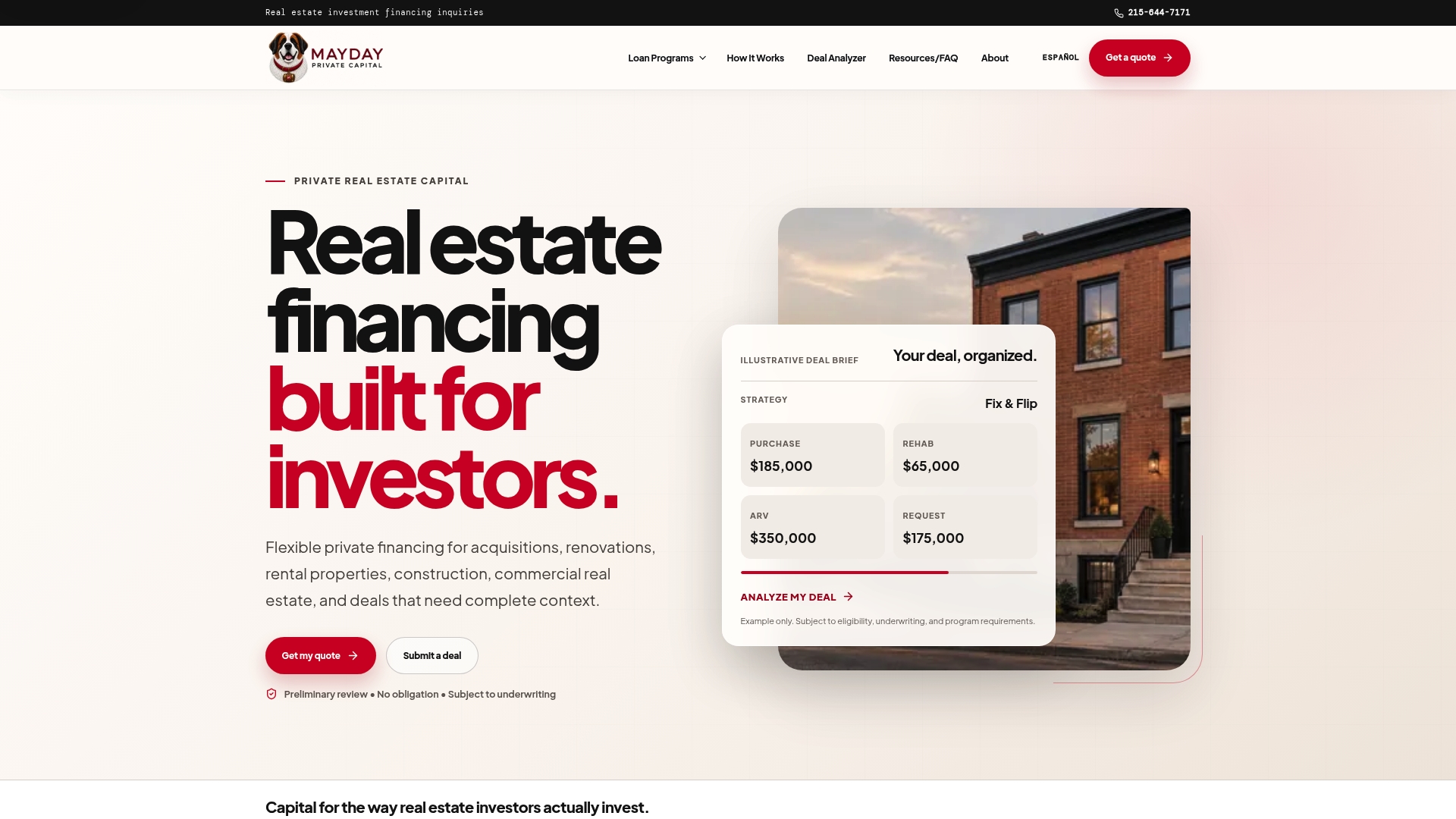
What sets the process apart is the conversation itself. Instead of running your file through a checkbox system, Mayday's team looks at the full context of your property and investment strategy before quoting terms, then delivers a quick preliminary review so you know where you stand fast. Bilingual support means the conversation happens in whichever language works better for you. This fits first-time investors, borrowers with past credit challenges, and experienced landlords who just need a lending partner that moves at investor speed rather than bank speed.
Ready to see what your deal qualifies for? Start a pre-review and have your rent figures, entity documents, and target closing date on hand.
Sources
- Private Money Lending: How It Works & What It Costs (2026)
- Private Money Lenders: How to Find & Structure Deals | CapRateCity
This article is general information, not a substitute for advice from a qualified financial advisor. Consult a qualified financial professional about your own circumstances before acting on anything here.
FAQ
Is DSCR the Same as Transactional Funding?
DSCR loans are one type of transactional funding for investors. They cover rental property acquisitions and refinances using rent-to-payment ratios instead of personal income.
What Credit Score Do I Need for a DSCR Loan?
Most DSCR programs set a floor around 620, though scores closer to 720 or higher unlock meaningfully better pricing and higher leverage.
How Fast Can I Close on Transactional Funding?
A complete DSCR file typically closes in 21 to 28 days, while private money and bridge loans can move faster depending on the lender and how quickly title clears.
Can I Use Transactional Funding for a BRRRR Deal?
Yes. Bridge or private money typically funds the rehab and lease-up phase, then a DSCR refinance pays it off once the property is stabilized at market rent.
Does Mayday Private Capital Offer DSCR and Private Money Loans?
Mayday Private Capital provides flexible private financing for acquisitions, renovations, rentals, and construction, with terms built around each investor's specific deal.